Our Approach to Integrating AI in an Organization

Autonomy was not the starting point. It was the consequence of having strengthened the system around the agent.

Rashid Azarang7 min readEN / ES
Our Approach to Integrating AI in an Organization

What we have been building did not start with the idea of giving an agent more autonomy.

It started earlier, when we began strengthening the way we work as a team.

We started with the process

We made our processes more explicit: how we relate to the work, how we leave evidence, how we connect a story to a change, how we review, how we follow up, and how we understand the real state of a project.

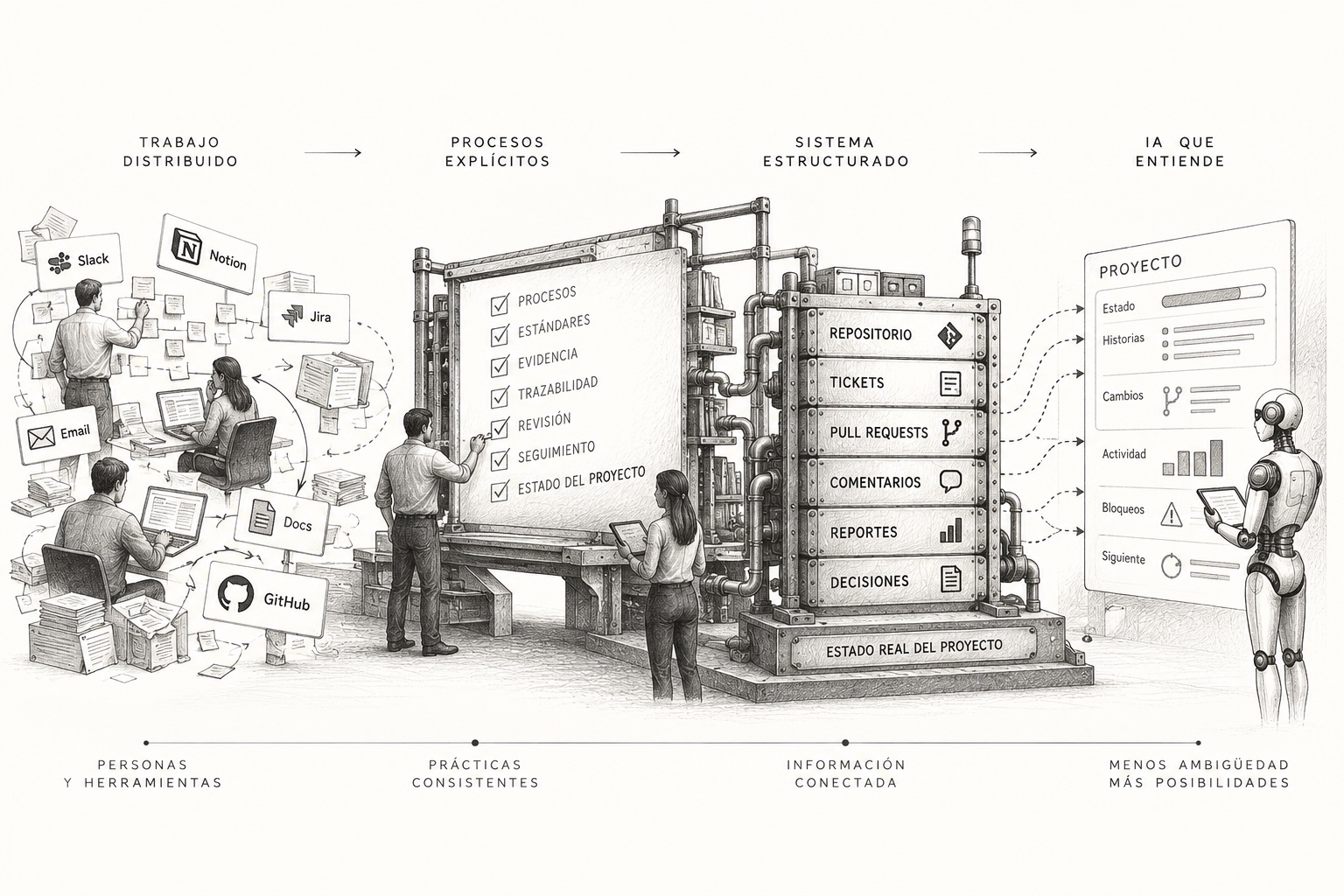
Many of those practices already existed, but they were distributed across people, tools and different ways of working. Slack held one part of the conversation. Jira another. GitHub another. Documentation, reports and decisions lived in different places.

The first change was not introducing more AI. It was making the system clearer.

As the processes became more consistent, visible and traceable, we also began to reduce the ambiguity around the work.

And when ambiguity goes down for people, it goes down for agents too.

From distributed work to an understandable system: separate people and tools; then explicit processes; then a structure where the repository, tickets, pull requests, comments, reports and decisions begin to represent, together, the real state of the project. On that structure an agent can operate with far less implicit context. Labels in the figure are in Spanish.

Autonomy as a consequence

That changed our relationship with AI.

At first, agents required a lot of supervision. They needed specific instructions, context explained again and again, and careful review of every step.

But as the environment took shape, what we could delegate changed as well.

The agent no longer had to rebuild the project from scratch every time it started a task. It could better understand where things stood, which rules to follow, which information to consult, which actions were valid and what evidence it had to leave behind.

Autonomy, then, did not appear because we decided to "make the agent autonomous".

It appeared because the system around the agent became clear enough to allow it.

That changes quite a bit about how we understand AI integration.

Instead of starting by asking how much an agent can do on its own, we started by asking how well structured the environment has to be before we can trust it with more work.

Information as a continuous architecture

As we refined those processes, our relationship with information began to change too.

We stopped seeing it only as something a person looks up when they need it, and started treating it as an active part of the operation.

The repository, the tickets, the pull requests, the comments, the reports and the decisions stop being only historical records. Together they begin to form a living representation of the state of the project.

And on that representation, new capabilities can be built.

We can have monitors that watch for changes. Routines that review the state periodically. Agents that detect inconsistencies, find blockers, generate reports or react to certain events.

Information stops being only something we store.

It starts being something the system can reason about continuously.

That is where the idea of a continuous architecture appears for us: an architecture in which the project keeps an active relationship with its own state.

A persistent environment

The next step is to consolidate that operating knowledge inside a persistent environment.

An environment that keeps the project up to date, but also the metastructure we have been building around it: the rules, the context, the processes, the observation mechanisms, the traceability, and the ways an agent should interact with the system.

That environment does not aim to become "the main agent".

Its job is to maintain continuity.

Models can change. Interfaces can change. We can work from a terminal, Cursor, another IDE, another harness or various specialized agents.

But the project keeps its structure and its way of operating.
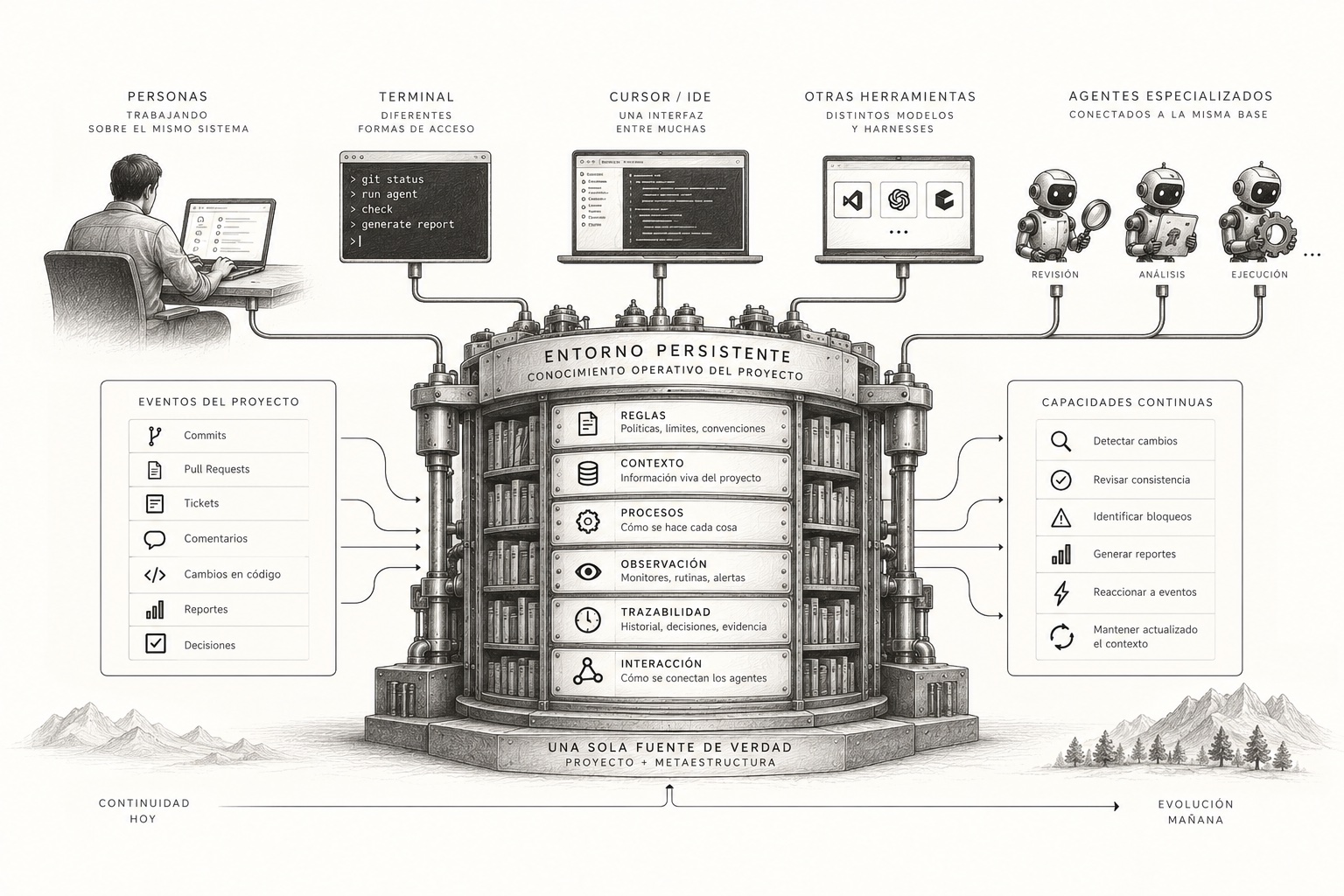
In that sense, the persistent environment becomes a source of continuity between the people, the tools and the agents working on the project.

On one side it receives what happens: commits, pull requests, tickets, comments, code changes, reports and decisions.

On the other, it maintains permanent capabilities: watching for changes, checking consistency, identifying blockers, generating reports, reacting to events and keeping the context current.

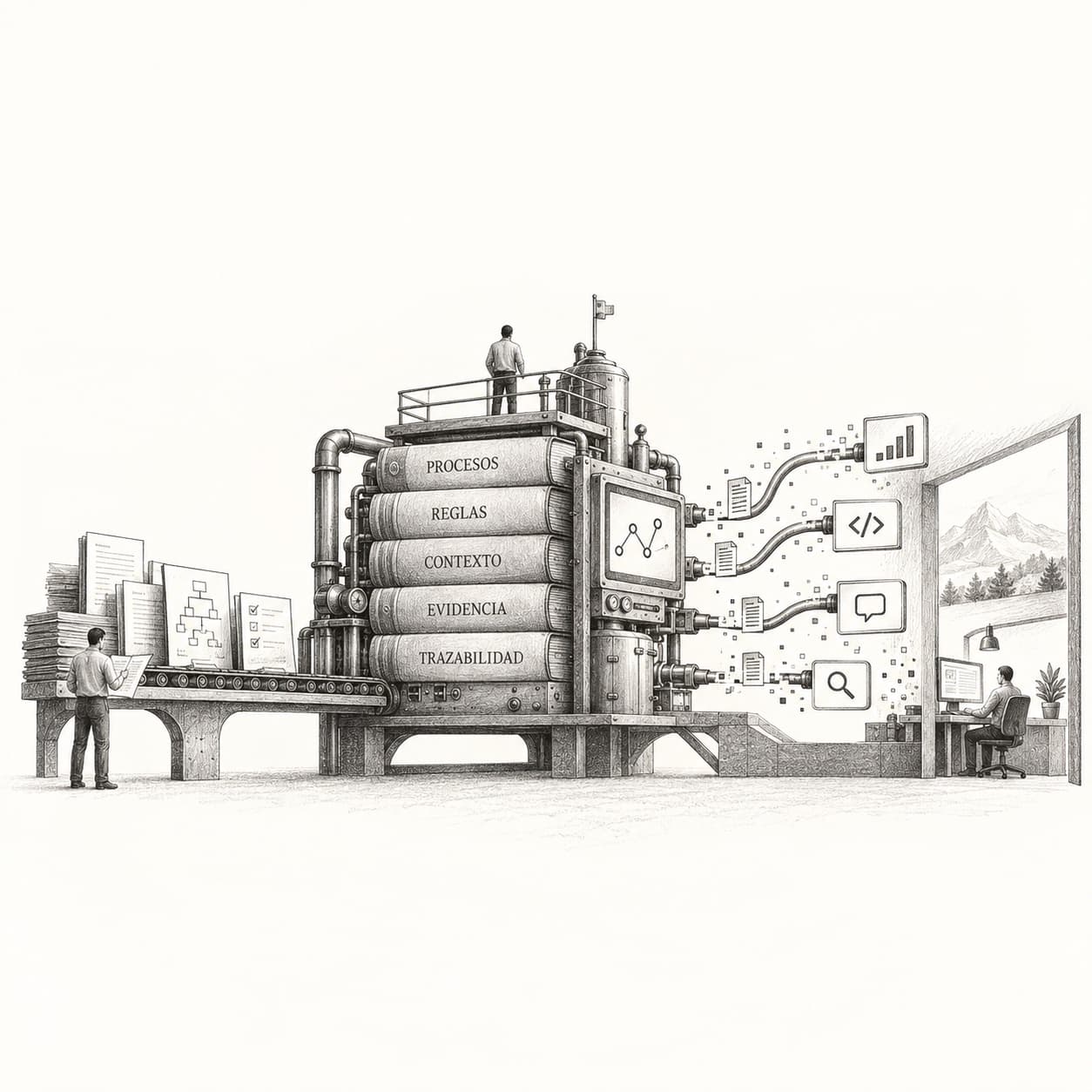
The persistent environment as a single source of truth, project plus metastructure. On top connect people, a terminal, Cursor or another IDE, other tools and specialized agents. On one side the project's events come in; on the other the permanent capabilities go out. In the middle, what provides continuity: rules, context, processes, observation, traceability and interaction. Labels in the figure are in Spanish.

A common interface

That is the point we now want to consolidate.

We do not want every person to have to learn how the whole agentic system works on the inside before they can use it.

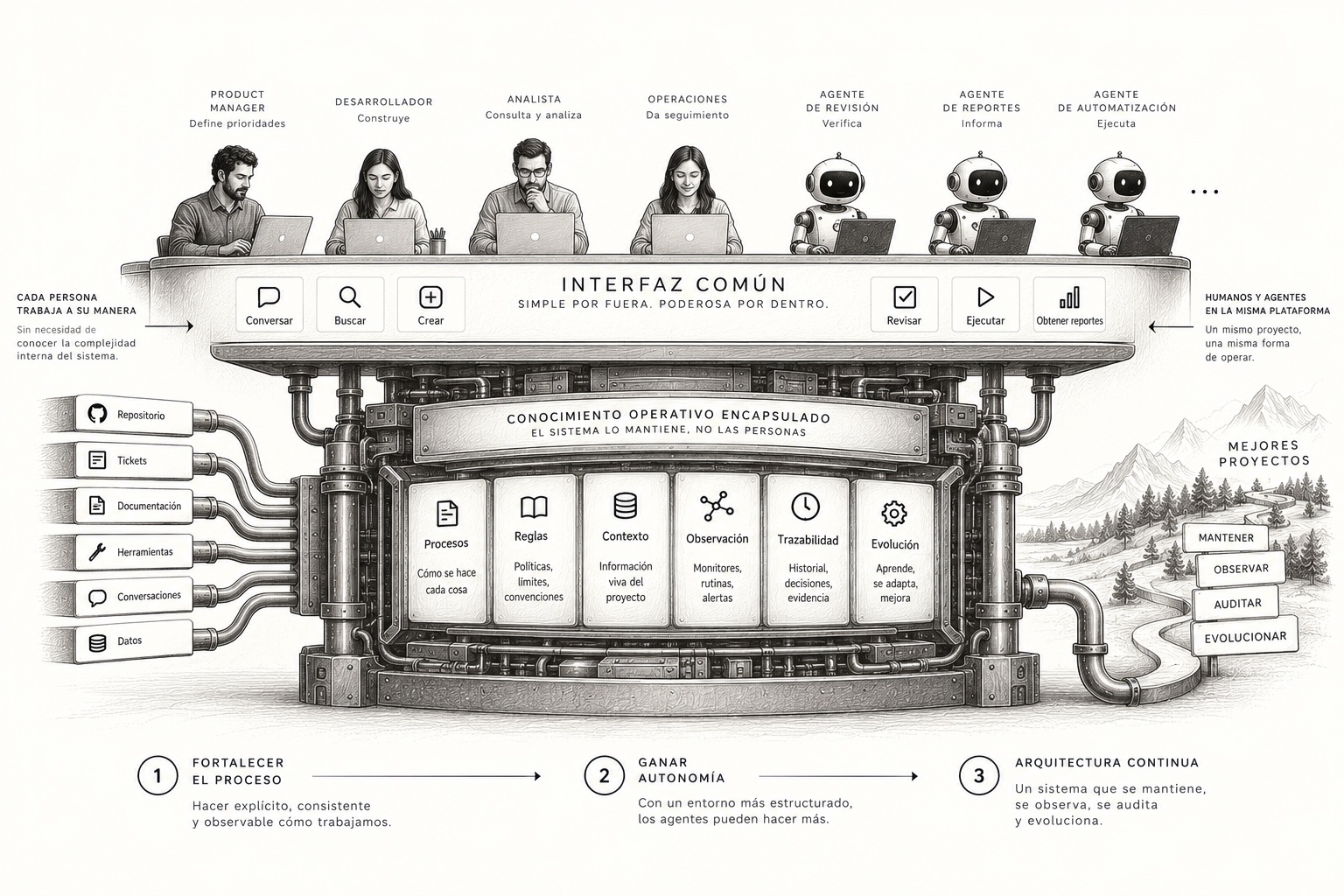
We want to encapsulate that operating knowledge and project it as a common interface on which both people and agents can work.

A product manager can interact from one tool. A developer from another. An analyst can ask for an explanation of the project's state. A specialized agent can review a change. Another can prepare a report.

All of them can be working on the same underlying structure.

On the outside, the interaction can be simple.

On the inside, the system keeps its processes, rules, context, observation, traceability and mechanisms for evolving.

The complexity does not disappear. It is encapsulated.

The common interface: people in different roles and review, reporting and automation agents work on the same platform, simple on the outside and powerful on the inside. Below it, the encapsulated operating knowledge that the system maintains, not the people. At the foot, the order: strengthen the process, gain autonomy, continuous architecture. Labels in the figure are in Spanish.

And that lets AI integration start to look less like teaching each person how to operate agents, and more like giving them access to a capability that already understands how the system works.

First the process, then the autonomy

That is, so far, our approach to integrating AI inside an organization.

First we strengthen the process.

Then we make the operating knowledge explicit.

In doing so, we reduce ambiguity and can delegate more.

That delegation lets us gain autonomy.

And as autonomy grows, we need an architecture capable of holding context, observing itself, leaving evidence and evolving.

That is why we do not see autonomy as the beginning of this process.

We see it as a consequence.

And the end goal is not to build an agent that knows the whole project either.

It is to build a system that keeps enough structure and continuity for different people and different intelligences to come in, understand where they are, and work on it without rebuilding the context every time.

Instead of continuously transferring the knowledge of how to operate the system, we want that knowledge to become part of the system itself.

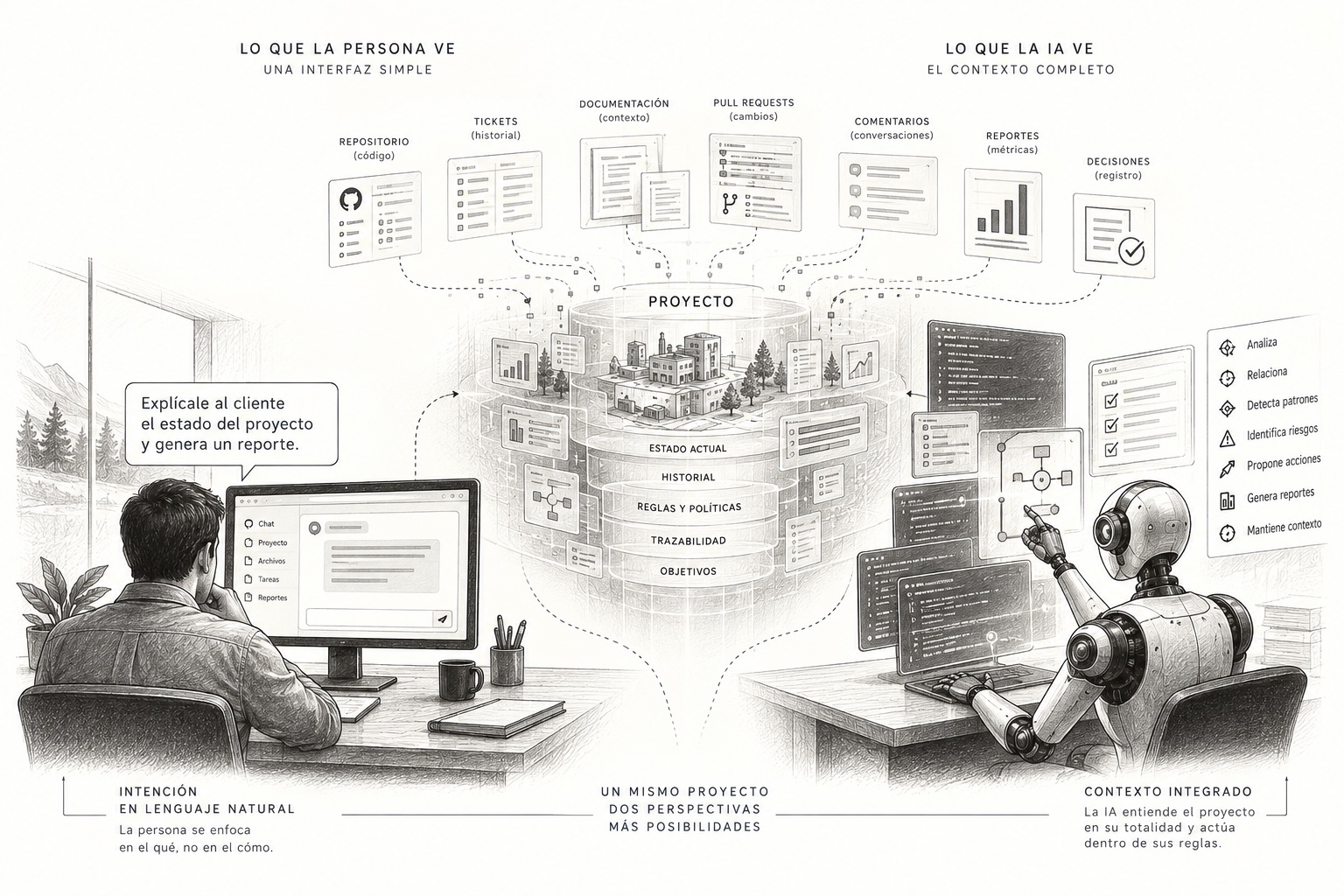
One project, two perspectives. On the left, what the person sees: a simple interface and a request in natural language. On the right, what the AI sees: the full context of the project, with its state, its history, its rules, its traceability and its objectives. The person focuses on the what; the system keeps the how. Labels in the figure are in Spanish.

More from the blog

Further reading