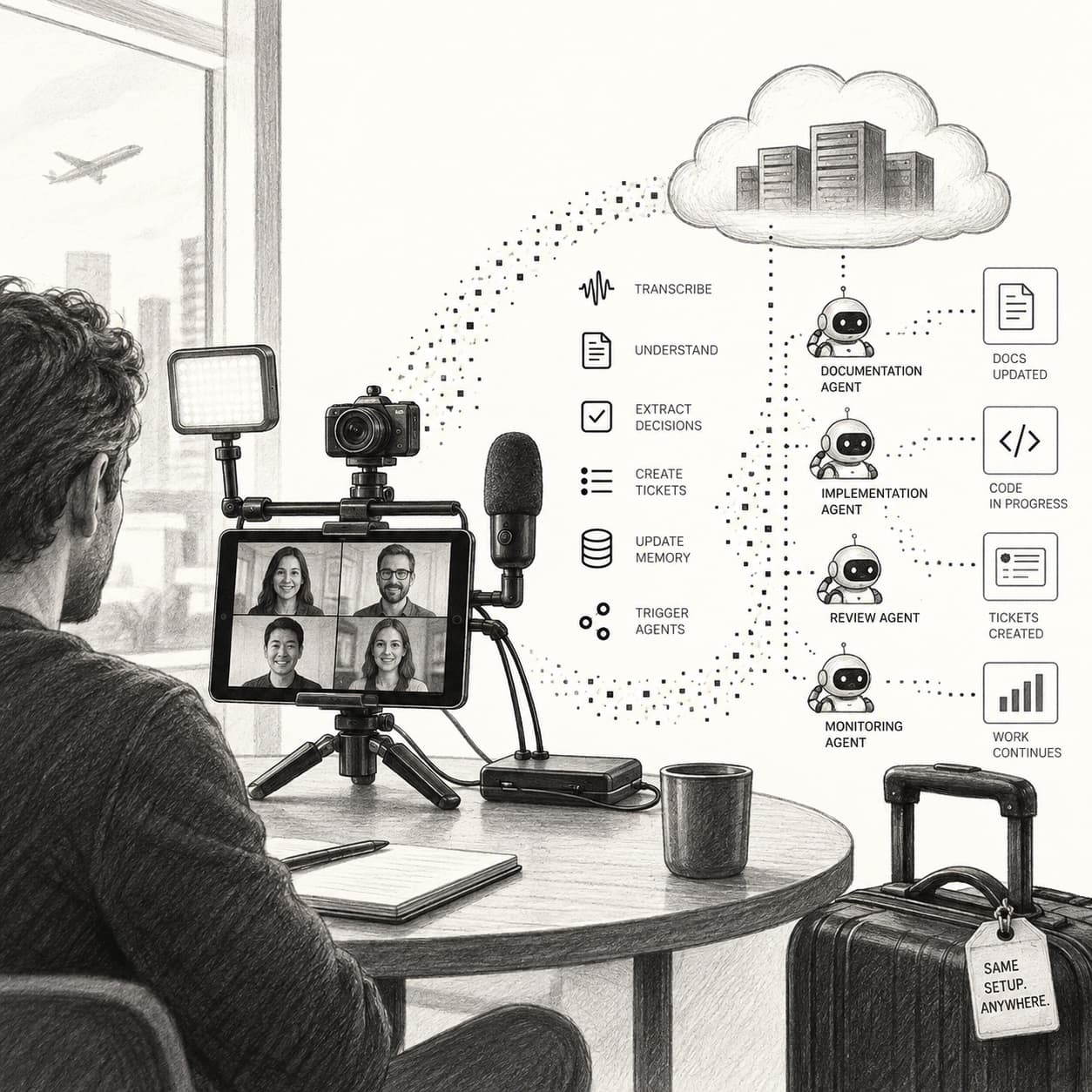
I started this as a video-call setup.
I had an iPad mini sitting around that I barely used, and I wanted to turn it into something more deliberate: a small, portable station for meetings. External camera. Better audio. Proper lighting. A USB-C hub. Enough battery to run for hours without depending on a wall outlet.
At first, the problem looked physical. How do I make the camera, microphone, light, hub, battery and iPad behave like one system? How do I mount everything cleanly? How do I make it portable enough to take to a hotel, a client meeting or another room without rebuilding the setup every time?
I wanted the same framing, the same lighting, the same sound, the same interface. A repeatable environment.
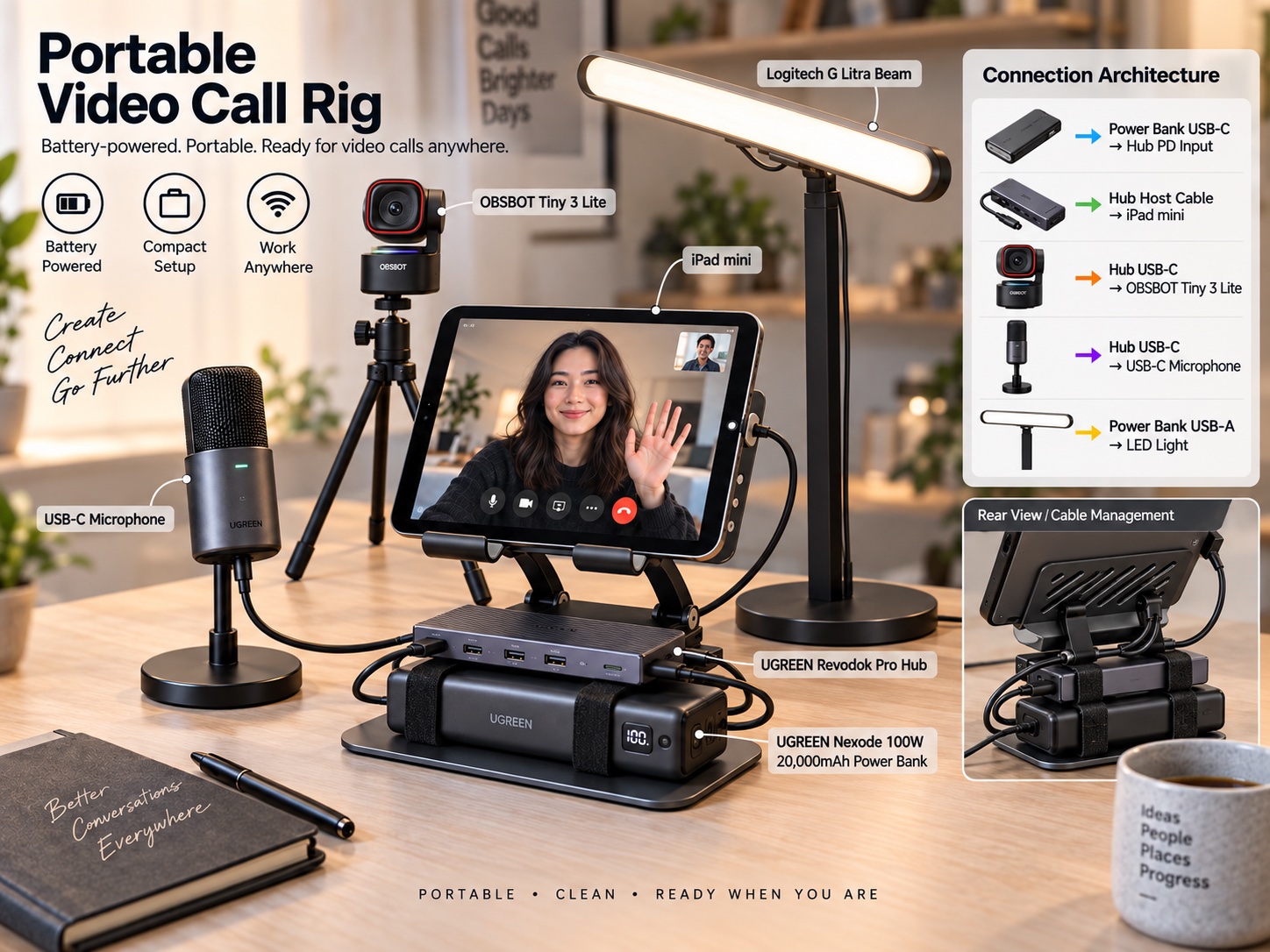
But while I was designing it, I realized the hardware was solving a much more interesting problem.
The laptop becomes an interface
I have been working increasingly with agents that do not behave like short-lived coding assistants.
Some sessions run for long periods. Others wake up on schedules. Some react to tickets, comments, builds or other events. Some run loops looking for useful work. Others operate against goals for 24 or 36 hours at a time.
The more persistent the architecture becomes, the less useful it is to think of my laptop as the place where the work happens.
The laptop becomes an interface.
The actual work can happen elsewhere: on a host machine, on a server, in cloud environments, inside repositories, through ticketing systems, monitors, agents, pipelines and review loops.
That led me to a simple question. If the software architecture can keep working while I am away from the computer, why do my meetings still depend so heavily on me being at the computer?
I am the integration layer
That started to feel like a bottleneck.
I can have agents running continuously, but I still have a meeting, close the call, open my laptop, write notes, copy context, create a ticket, explain the conversation again, point an agent at the right repository, and then wait for the system to pick up where the human conversation ended.
There is a discontinuity there.
The meeting happens in one world. The work system lives in another. And I am the integration layer.
That is what I want to remove.
A physical agent harness
The setup I am building started to make more sense when I stopped thinking of it as a video rig and started thinking of it as a physical agent harness.
A physical agent harness is the hardware boundary between human activity and an agentic system.
In my case, it starts with the meeting.
I sit down in front of the iPad. The camera, microphone and light are already configured. The environment is standardized whether I am in my office or traveling. I take the call.
The conversation is transcribed. A system like Granola can capture the meeting, and an agent connected through its MCP can begin doing something more useful than simply producing notes.
It can understand what the meeting belongs to.
This was a conversation with Client A. It belongs to this workspace. These decisions were made. These commitments were created. This needs to become a ticket. This part belongs in the project memory. This document needs to be updated. This action should wake another agent.
The meeting stops being a piece of text I have to process later. It becomes an event. And that event enters the same infrastructure where the rest of the work already happens.
From conversation to execution
A transcript might land in a repository under something like /docs/meetings/. A monitoring process notices it. An agent reads it using a specialized skill. It extracts decisions and tasks. Those become tickets. The tickets are tagged. Another agent environment reacts to those tags.
One agent might update documentation. Another might work on implementation. Another might review the resulting work. A monitoring session can continue watching the ticket for changes.
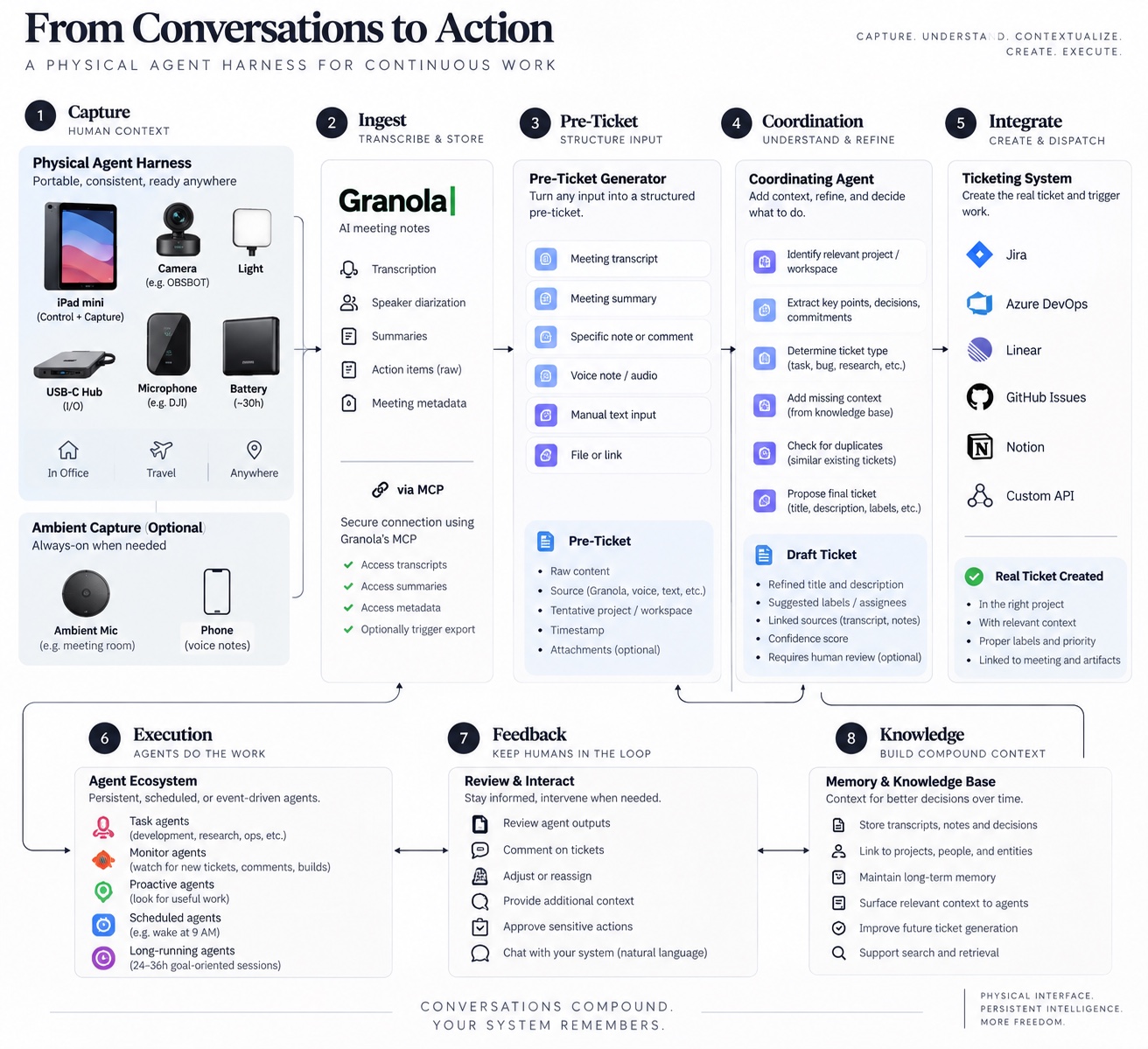
The conversation becomes execution. That is the transition I care about.
The physical harness captures the part of the world that agents normally cannot see: human conversations, intent, context, decisions, relationships, nuance.
The software harness handles what happens next.
The hardware, reconsidered
Once I started thinking about it this way, the design of the hardware changed too.
The battery is not just there because I want a portable webcam. I want the system to be able to operate independently for long periods.
The iPad is not just a small display. It is a lightweight control surface.
The camera is not just about looking better on a call. It is part of a standardized capture environment.
The microphone is not merely an audio accessory. It is an input sensor for a persistent knowledge and execution system.
Even the fact that the setup can move matters.
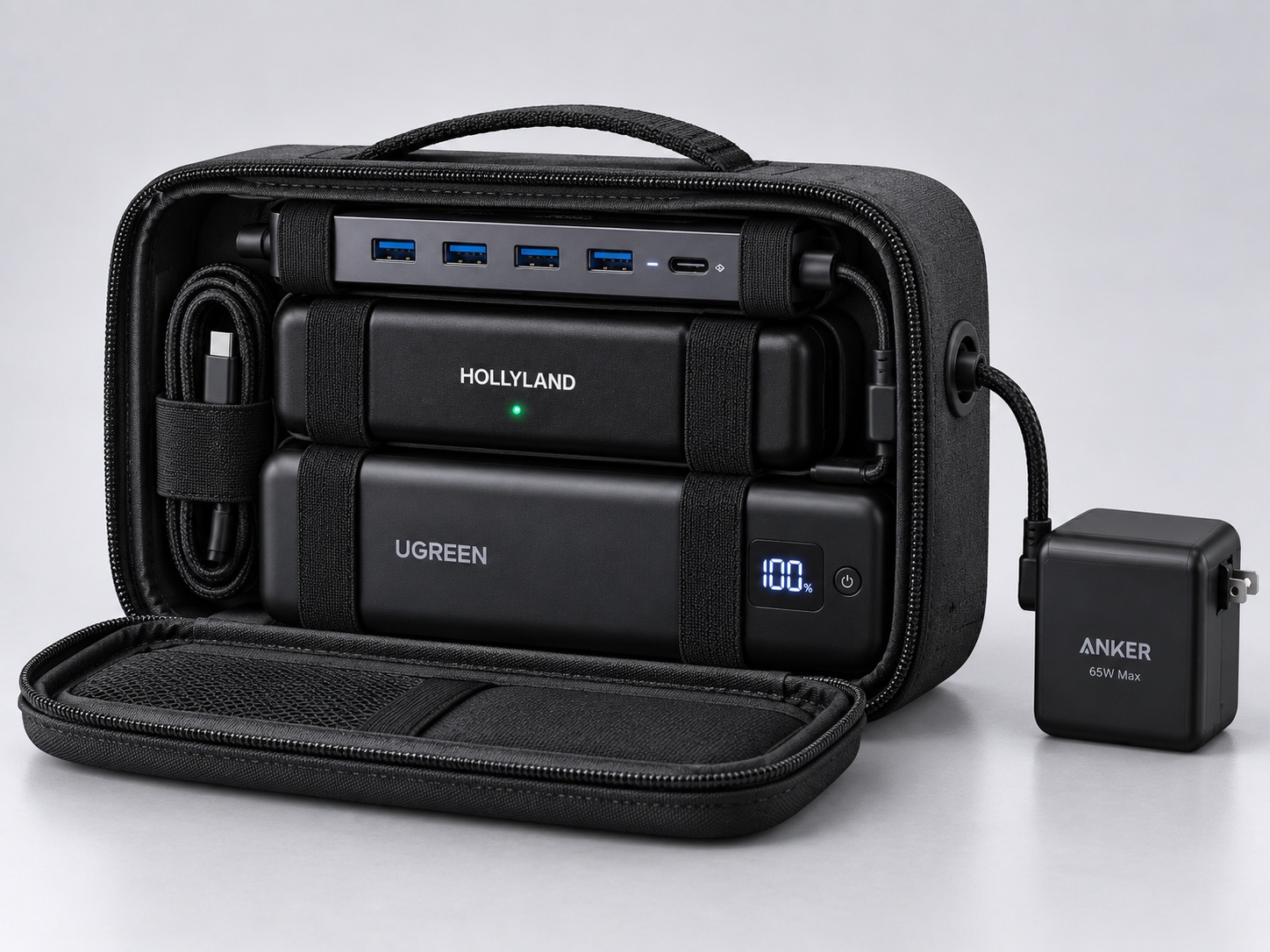
I want to be able to take the same physical interface with me. Office. Hotel. Airbnb. Client site. Another country.
The room changes. The architecture does not.
That means I can begin to separate my ability to produce work from my physical location. The heavy systems can remain at home or in the cloud. My personal machine can stay lightweight.
If I need to interact with the host, I can connect through a VPN or terminal. If I need to assign work, I create a ticket. If I need to inspect something, I review the result.
And if I need to generate new context, I have a conversation.
Moving upward
This becomes especially interesting once the agent system itself becomes persistent.
Imagine a host machine running a collection of specialized environments. Some agents wake at 9:00 AM and check for tickets. Some watch for comments. Some monitor repositories or deployments. Some operate continuously in loops. Some work against longer-lived goals.
The system does not require me to sit there watching it.
My responsibility gradually moves upward. Instead of performing every step, I define intent. I review important output. I make decisions. I talk to people. I intervene when judgment is required.
There will always be things that are difficult to automate. UX review is a good example. An agent can check code, run tests, compare screenshots, inspect browser behavior, and even use a browser directly, but it can still miss something that feels obviously wrong to a human.
The answer, though, is not necessarily that I must personally perform all UX review forever. I can build another probe. A browser-capable design-review agent. A frontend reviewer. Another layer in the harness.
The point is not that everything becomes fully autonomous overnight. The point is that every repeated manual boundary becomes a candidate for systematization.
And meetings are one of the biggest boundaries I still see.
If I can automate 90% of the work but every important conversation still requires me to manually translate what happened into tickets, context, memory and agent instructions, then I remain the bottleneck.
The physical agent harness is my attempt to remove that bottleneck.
The endpoint
The endpoint I am aiming for is surprisingly simple.
I take the meeting. I explain what I think. I make the decision. I hang up.
And the architecture continues.
The transcript goes where it belongs. The memory updates. The ticket appears. The right agents wake up. The work moves forward.
By the time I return to the system, I am not reconstructing the conversation. I am reviewing what happened because of it.
That is the part that excites me.
The goal is not really remote work. Remote work still assumes that I am carrying the workplace around with me. This is closer to removing the requirement that the workplace follow me at all.
The computational environment stays where it is. The agents keep running. The infrastructure stays alive.
I carry only the interface. A lightweight computer. A camera. A microphone. A battery. And a small physical harness that turns my presence in the world into structured input for a system that can continue working after I leave.
The object may look like a portable video rig.
But that is increasingly not how I see it.
I see it as the human-facing edge node of my agent architecture.