The test I could not run alone
A few months ago I wrote that speed is not a personal trait but an emergent property of cognitive infrastructure. I wrote it from inside my own garden: my repos, my conventions, my accumulated context. A fair objection was always available: of course it works there. You built every wall.
Then I joined a global university network as an AI engineer, working on a conversational agent that handles enrollment, scheduling, routing, and support. A real organization, with years of history, dozens of repositories, a board with hundreds of tickets, and conventions that predate me. The perfect place to run the test: does the infrastructure thesis transfer, or was it a greenhouse effect?
The workspace comes first
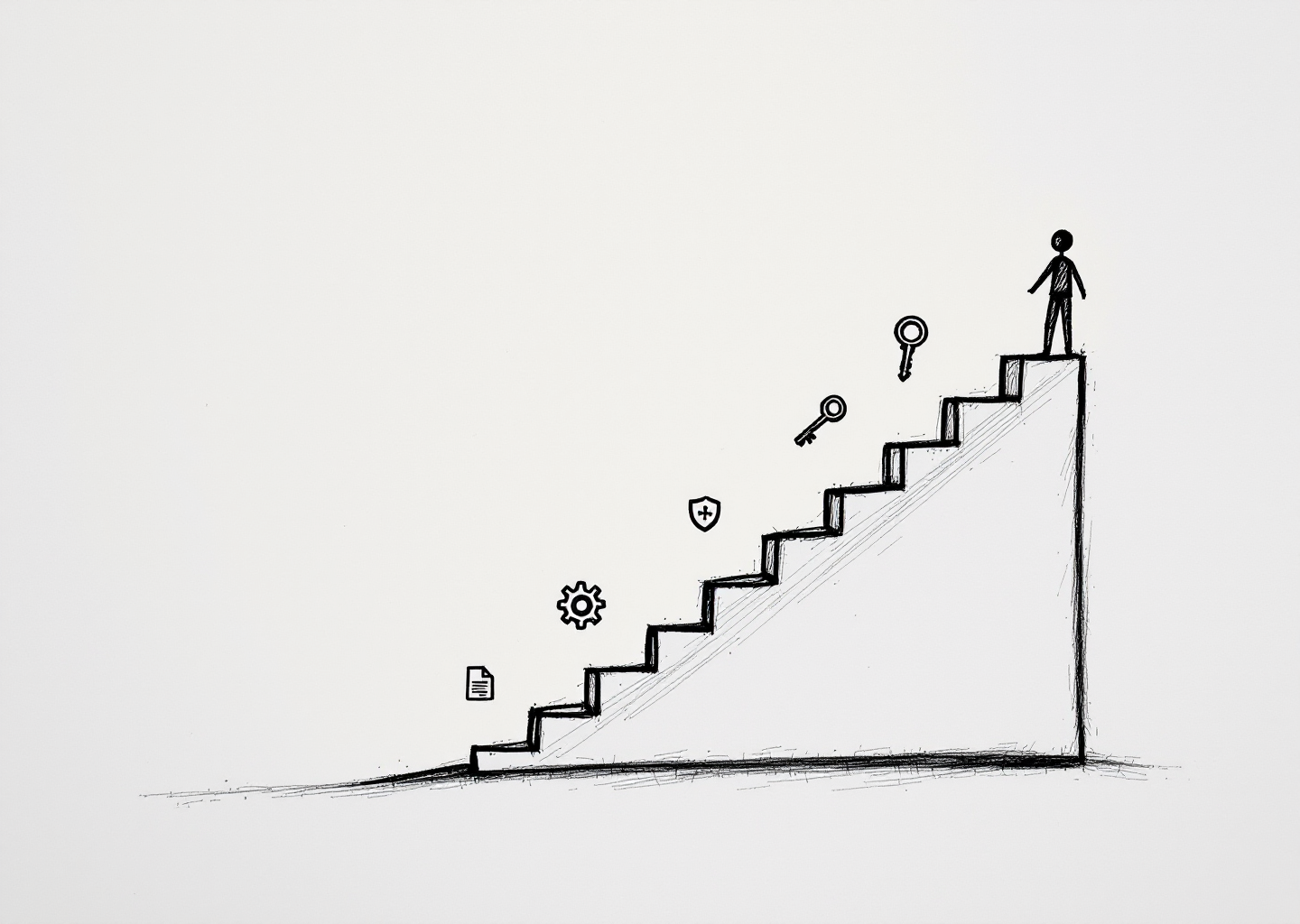
My instinct on arrival was not to grab tickets. It was to build the workspace: a parent layer that sits above the organization's repositories and turns the terrain into something my tools and my agents can read.
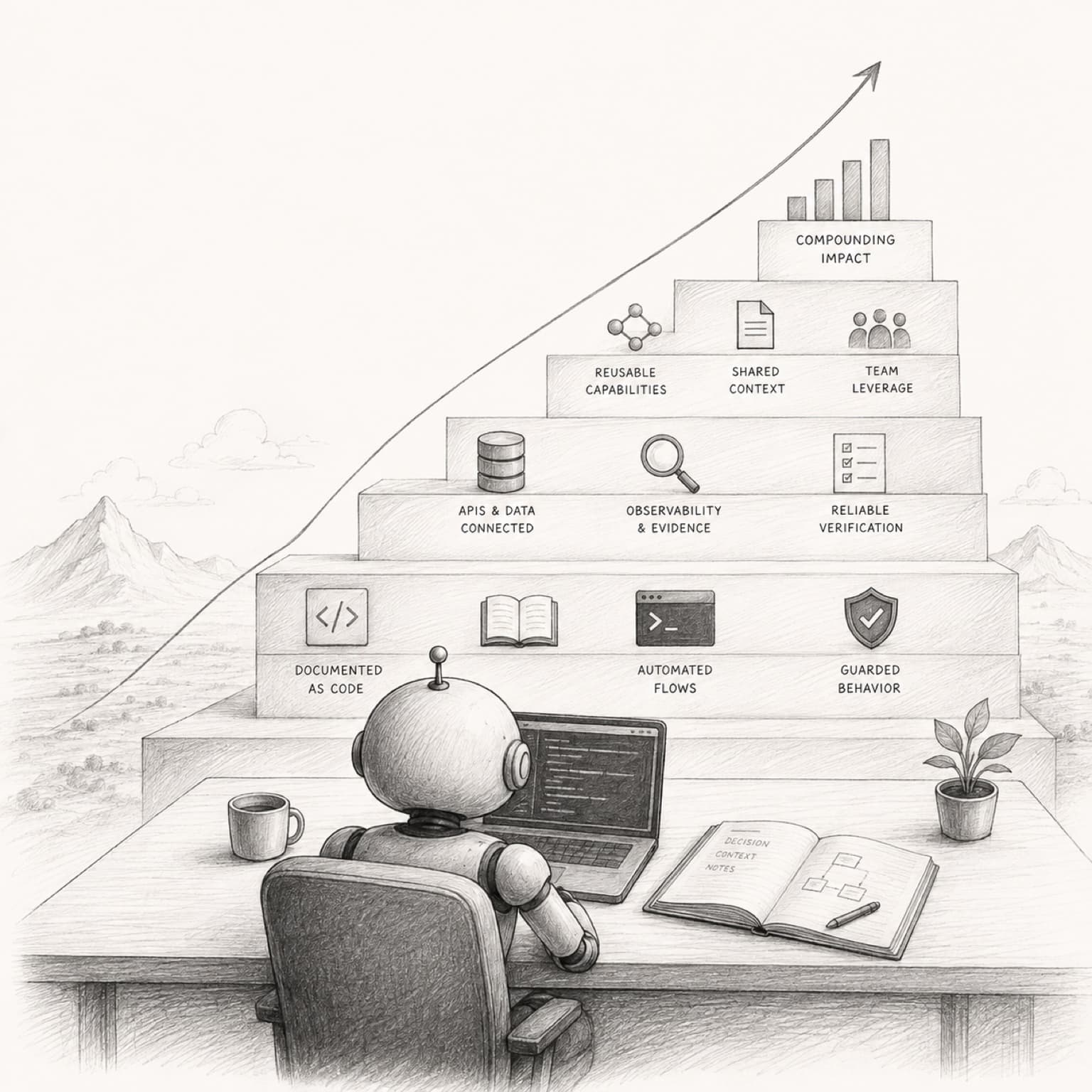
It looks unremarkable from the outside. Every repository I can see, cloned and cataloged in a machine-readable map. An agent contract at the root, so any session starts already knowing the terrain, the boundaries, and the rules of engagement. Documentation written as code, versioned next to what it describes: if a decision is not in the repo, it does not exist. The board's API wired, the git hosts wired, the cloud logs wired, so questions get answered by commands instead of by interrupting a colleague. Health scripts that produce evidence instead of impressions. Recurring flows condensed into commands. Monitors that watch a long evaluation and wake me with the verdict while I prepare the branch it will gate.
None of this is a deliverable. Nobody asked for any of it. For the first days it looks like slowness: the new person is drawing maps while the board is right there, full of work.
What compounding looks like
Then the curve bends, and it bends fast, because each capability makes the next one cheaper.
Because the board's API is wired, I can audit the entire backlog against reality instead of reading it one ticket at a time. Because the repos are cataloged, an agent can trace a behavior across services in minutes. Because I can probe the live agent and capture every tool call it makes, a story marked done can be verified instead of believed, and the gap between status and conduct becomes visible. One afternoon that gap was a single ghost key: a prompt rule asking for a field the real contract never emits. Nothing had crashed. Nothing would have surfaced it except the audit.
Because every finding lands in a doc that both people and agents read, nothing is derived twice. Because every fix leaves an automated guard behind it, the system's guaranteed behavior only grows. The workspace remembers, so I do not have to.
This is the part that is hard to convey until you witness it: the capabilities compound. Wiring the board made audits possible. Audits made honest evidence normal. Evidence built trust. Trust widened scope, and wider scope justified wiring the next API. Week four runs on rails that week one had to lay by hand. The same person, the same hours, and visibly more force per decision, because almost nothing starts from zero anymore.
The unit of progress is the capability
Organizations measure work in tickets, and tickets matter: they are how value ships and how teams coordinate. But watching this month unfold convinced me the ticket is the exhaust, not the engine. The unit of progress underneath is the capability: one more API answerable by command, one more contract verified against the world, one more flow that runs itself, one more behavior under guard.
A closed ticket is worth one ticket. A capability keeps paying every week after. This explains a pattern that pure effort cannot: two people can work the same hours on the same board and diverge, not because one types faster, but because one of them is accumulating capabilities while the other is only closing tickets.
The speed essay ends by saying that when infrastructure changes, everything built on top of it changes too. The month inside a real organization taught me the corollary: infrastructure is portable. Not the files, but the practice. Arrive, build the layer, wire the terrain, let it compound.
The workspace comes first. Everything else is interest.