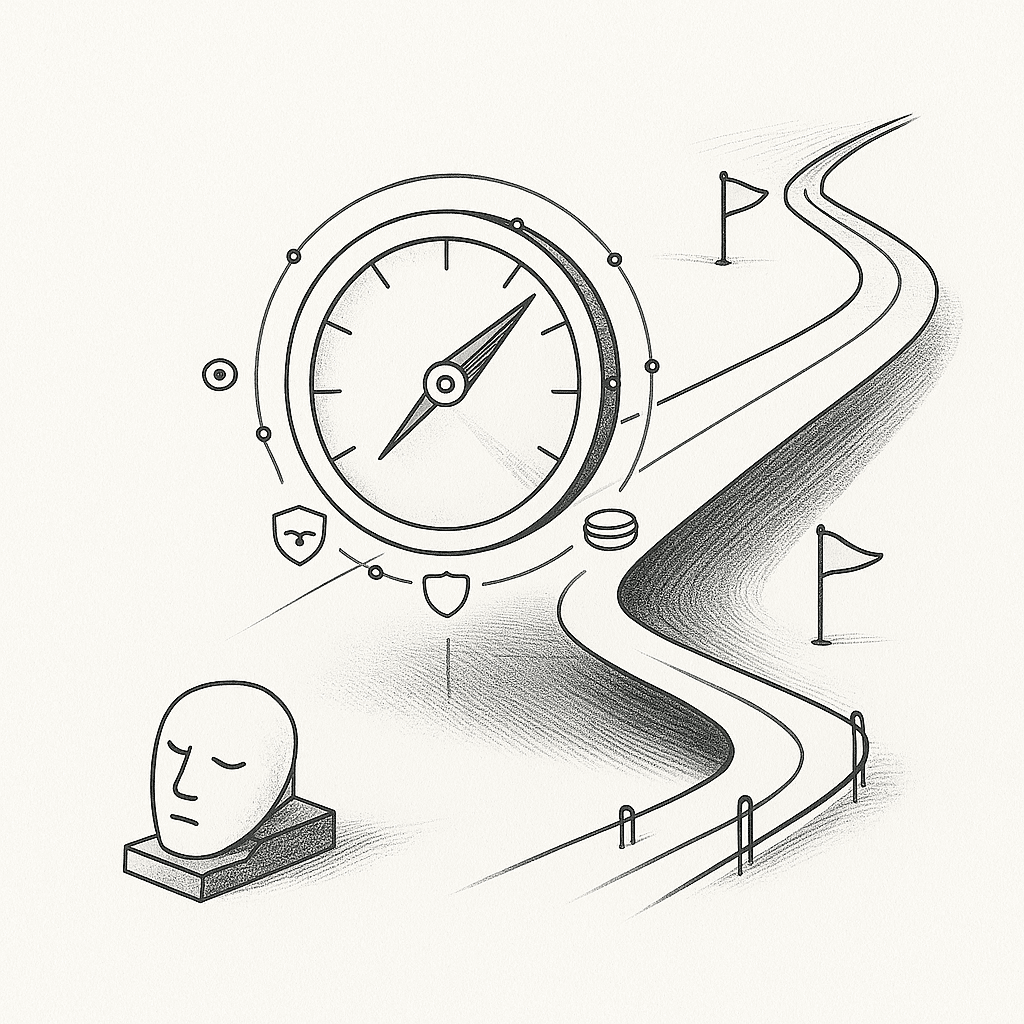
The old definition of speed
When people hear that someone became faster with AI, they imagine a person who types faster, thinks faster, works longer hours, or juggles more tasks.
That is not what happened to me. I type at the same speed. I sleep the same hours. My raw thinking is the same. And still, my output has multiplied.
The explanation is not in me. It is in the system around me.
Speed is not a personal trait. It is an emergent property of cognitive infrastructure.
What actually changed
Over the last years I built a workspace around my work. Not a single AI tool. A layered environment: memory that persists between sessions, reusable prompts, workflows that turn repeated processes into single commands, automation, guardrails that catch mistakes before they spread, documentation written for agents as much as for people, several agents working in parallel, and context that accumulates from one project to the next.
Each piece is small. Together they form a second cognitive layer that lives outside my head. It remembers what I would forget, prepares what I would have to look up, checks what I would have to verify, executes what I would have to type.
My effective capacity has expanded because the surrounding system absorbs work that used to demand constant attention. That leaves more bandwidth for architecture, judgment, and product thinking.
The right comparison is not a better tool. It is roads, electricity, the internet. Infrastructure. When infrastructure changes, everything built on top of it changes too.
The bottleneck moved
Work used to flow like this:
Idea
↓
Execution
↓
Result
Execution was the expensive step, so organizations were designed around it. Roles, estimates, sprints, handoffs.
Now there is a new layer in the middle:
Idea
↓
AI workspace
↓
Execution
↓
Result
When the workspace is mature, execution becomes cheap. Things that took a week take an afternoon. But the total time from idea to result does not shrink at the same rate, because the bottleneck moves. It moves to alignment, decisions, reviews, communication.
This is where organizations struggle. Their structures assume execution is the constraint. When one person's infrastructure changes dramatically, that person can produce in hours what the surrounding process needs weeks to absorb.
If the unit of work changes, collaboration has to be redesigned too. Not so that everyone runs at maximum speed, but so that coordination sits where the real constraint now lives.
The internal shift
There is also a psychological side, and Jung gave me the vocabulary for it.
For years I lived close to what Jung calls the persona, the collaborative identity I developed. I kept my rhythm adjusted to what felt digestible for collaborators. That brake was not a lack of power. It was an act of care.
Then the external constraints disappeared, and I noticed something unexpected: some of my internal constraints were no longer necessary either. What used to be a real limitation had become a habit.
Jung calls this movement individuation, a shift from pleasing the outer image toward honoring the inner pattern. Anyone who builds this kind of infrastructure will face a version of it. When the system around you stops slowing you down, you meet your own habits of self-limitation directly.
Shadow
More light casts more shadow. The infrastructure magnifies strengths. It also magnifies everything else:
- Ego. Producing more can start to feel like being worth more.
- Impatience. Other people's rhythms start to feel like obstacles.
- Tunnel vision. A system that executes your ideas quickly will also execute your bad ideas quickly.
- Isolation. If the workspace answers faster than your colleagues, you may stop asking your colleagues.
- Overconfidence. Fluent output looks like correct output. They are not the same thing.
Every item on that list is something I have caught in myself. The task is not to deny the shadow but to notice it, name it, and integrate it, so acceleration does not erase what is human in the work.
A working philosophy
What survives is a small set of principles:
Move at the speed your system can sustain, not the speed you can imagine.
Design recoverable work. Never trade trust, dignity, or coherence for pace.
Do not confuse throughput with wisdom.
Increase leverage without reducing empathy.
Build systems that elevate teams, not only individuals.
I no longer see my task as holding myself back so others can follow. I see it as learning to drive a more powerful vehicle with more consciousness, and helping the people around me build vehicles of their own.
Speed is not a personal trait. It is an emergent property of cognitive infrastructure. When one person's infrastructure changes, the organization has to change with it. Handled with care, that is not a threat to the human side of work. It is a way to serve it.