Abstract
Whether curated progressive disclosure helps or hinders an agent that could
instead search is now measured by several groups. Published designs measure
their curated arms by aggregate outcome (answer quality and token cost)
without per-read telemetry, so when a curated arm underperforms, the failure
cannot be attributed to the index's routing; the closest preregistered
neighbour records aggregate usage only and names direct read telemetry as a
target for replication. This paper supplies that instrument for the curated
arm. In a
pre-registered comparison over 102 frozen questions on a production corpus, we
strip the search tool from the curated arm, making an authored, model-written
one-line-digest index the policy's sole locator, and record, per question,
whether each
policy reached the gold document, measuring routing and not just accuracy:
the index located the gold document on 52.0% of questions
against grep's 80.4%. Of the curated policy's 47 wrong-stops (answers
given without ever reading the gold document), 43 had read a
wrong file and only 4 had read nothing; the policy issued more read events
than the search policy (192 vs 174, a descriptive count, untested); and
where the index did locate the
document, accuracy was 86.8% (replication: 76.0%), with a
difficulty-matched control
detecting no answerability difference in the questions it failed to route
(Fisher p = 0.80). A policy that
reads more and finds less is not stopping early on summaries. It is being
mis-routed by its index, and the mechanism is measurable: 44% of the
replication's questions share no content word with their own gold digest,
and a lexical signal proxy predicts localization by +21 points.
Downstream, search-then-read beats curated disclosure
on accuracy (72.5% vs 47.1%, +25.5 pp) and on error rate (27.5% vs 52.9%),
and is cheaper on marginal tokens (0.79×) while costing 1.41× on totals; one
prediction's unfrozen measure is disclosed as a defect of the method. A
pre-registered public replication over 141 releasable documents and 120 frozen
questions, under three deliberately harder criteria, returns search +12.5
pp on accuracy (63.3% vs 50.8%), the curated arm wrong-stopping on 34.2%
of questions against search's 18.3% under a symmetric rule the original
lacked, and a localization advantage of 75.0% against 62.5%, with 91.1% of
the curated arm's non-hydrated answers wrong (84.0% pooled across both
arms, the frozen form); its overall
verdict is revised, machine reason
headroom_not_established_on_marginal_tokens. In the same pre-registered
program, promotion of facts to a durable memory directory produced later
returns on 2 of 157 eligible files (refuted): the read path fails by
routing; the write path, on its registered population and measured channel,
is rarely read back. Predictions were frozen and
analyzers committed before any data were read; adjudication is mechanical
against criteria fixed in advance; the replication ships its corpus,
questions, harness and adjudicator for byte-identical re-running. We stake one
prediction for external replication, scoped to its substrate: an authored
one-line-digest index over a prose corpus, used as a sole locator, routes
worse than search on that corpus, and, under the same unhydrated-error
rule applied to both arms, its non-hydrated answers are wrong more often
than search's (the differential, not the level, is the falsifiable
quantity, §Invitation). We decline the neighbors: no claim about indexes
used alongside search (an unregistered successor), no claim that the accuracy
margin generalizes across corpora, and the tier-and-policy vocabulary used
throughout is working vocabulary, not a defended thesis.
Keywords: context engineering; agent memory; retrieval routing; progressive disclosure; pre-registration; LLM agents.
Discipline carried from the governing program and observed throughout: every quantity cites a source path; no outcome of unadjudicated work is anticipated (the covered C26/C27 re-runs, the registered-but-unadjudicated successor conjectures c26b and c28b, the index-plus-search successor, and the candidate conjecture c30 are pre-judged nowhere); no self-assigned quality score appears.
§1 The question and the result
When an agent's only way to find content is an authored index, how often does the index route it to the right place, and what happens downstream when it does not? This paper measures that question under pre-registration and reports the anatomy of the answer. On 102 frozen questions over a production corpus, an authored one-line-digest index used as a policy's sole locator routed to the correct document on 52.0% of questions; associative search over the same corpus, 80.4%. The curated policy issued more Read events than the search policy in both studies (a descriptive count that includes re-reads, untested; §4.1) and found fewer of the right files; of its 47 wrong answers issued without the correct document in context, 43 came after reading a wrong file. Where the index did route correctly, accuracy was 86.8%, indistinguishable from an oracle approximation, and a difficulty-matched control detects no answerability difference in the questions themselves (Fisher p = 0.80; §4.2 states the interval and what it can and cannot carry). The failure of curated retrieval, where it fails, is a routing failure of the authored layer, not a comprehension failure of the model and not an early-stopping choice of the policy. A pre-registered public replication at power reproduces the direction on a corpus a reader can hold in full (§5).
The comparison itself sits in newly crowded territory. Cochran's preregistered ablation of progressive disclosure on a frozen 709-page wiki includes an enforced read-only condition whose tool whitelist blocks corpus-wide search (agents attempted it on 39 of 320 enforced runs, all blocked) and finds curated access non-inferior on quality at 30–58% lower cost, while observing in its unrestricted condition that capable agents bypass the index by inferring page paths [39]; He et al. compare disclosure designs against a hybrid retriever across three harnesses and find single-level disclosure sufficient [40]; grep-based search has been measured against vector retrieval across harnesses [41]; skill-catalog organization has been measured for its runtime effects [42]; and direct corpus interaction (an agent searching a raw corpus with grep, file reads and scripts, no retriever at all) has been measured against sparse, dense and reranking baselines with a trajectory-level coverage metric that counts a gold document as surfaced when it appears in the recorded trace as a retrieved snippet or as a file returned by a tool call [43]; and the skill-routing literature points routing telemetry at authored one-line digests at scale: hiding the digest's body costs 37–44 pp of routing accuracy over ~80K skills [47], triggering from name-plus-description is unreliable across models and harnesses [48], and library growth decomposes into wrong selection against degraded execution [49]. What none of the document-corpus curated designs records is the read level: Cochran's harness "recorded only aggregate usage," and his paper names direct read telemetry as a target for replication [39]. Without it, a curated arm's failure cannot be located: it could sit in the index's routing, the policy's stopping, or the model's comprehension. The design here brings the read level to that arm independently (§3; §9's dating note): per-question gold-file logging on a prose corpus whose authored digest index is the sole locator, which is what converts "curation underperforms" into an attribution: the index mis-routes, and the anatomy of its mis-routing is measurable. §9 maps where every piece of that instrument already exists in neighboring literatures.
An agent's effective memory is more than its context window: contract files loaded at boot, catalogs of skills and tools, durable memory directories with index files, workspace filesystems reachable by search, and structured stores reachable only through tools, a configured tier whose measured ablations find weak, largely content-independent correctness effects [11, 60, 61]. The authored index tested here is one tier of that larger allocation, and the broader question, what earns which allocation, motivates the program this paper reports (§2 supplies the vocabulary). Within that program, this paper contributes:
- The mis-routing anatomy (§4): read-level telemetry on a document-corpus curated arm, the decomposition of its failure into located/mis-routed/unread, a difficulty-matched oracle control (unregistered in both studies, computed post-verdict, descriptive; §4.2), and the measured mechanism (§5: the digest-signal share and its +20.7-point localization split). The isolation itself is shared ground: Cochran's enforced arm achieves it [39], and skill routing measures the same deficit class on skill registries [47]. The anatomy and the control are what this arm adds, and both now also re-derive from the public replication's shipped records (§5).
- A public replication at power under deliberately harder criteria (§5): 141 releasable documents, 120 frozen questions, a symmetric wrong-stop rule, and a token-headroom prediction frozen on the measure the original study's own disclosure said should have been frozen, which then failed, making the replication's verdict revised.
- A write-side result under the same discipline (§6): in the same ecosystem, promotion of facts to a durable memory directory produced later returns on 2 of 157 eligible files: refuted under frozen criteria, with its channel caveat and its evidential weight stated rather than averaged into the read-side result.
- The method as instantiated (§7): predictions frozen before data, analyzers committed before first output, mechanical adjudication, floors enforced against the author's interest, and negative and self-correcting results reported as first-class.
It is not a system and not an architecture proposal; every result it reports was adjudicated mechanically against criteria frozen before any probe ran.
§2 Vocabulary: tiers, policies, and the metrics of stopping
The measurements below need a small fixed vocabulary, stated once:
An agent's effective memory is a set of tiers, each with (capacity, access cost, persistence, addressability, staleness risk), governed by five policies: residency (what loads at boot), paging (what's fetched on demand), promotion (what graduates to durable memory), eviction (compaction), validation (staleness checks).
The five policy names are taken from classical cache and virtual-memory design [14, 15, 16], and the borrowing is deliberate. Two things are not in that vocabulary. First, residency splits into content residency and pointer residency: a resident pointer (a name, a one-line digest, an index entry) is progressive disclosure formalized: the resident pointer is the low-resolution representation, the paged body the high-resolution one. A cache line is never a pointer to its own contents, so cache design has no occasion to draw this line. Second, staleness risk is a tier property: OS paging is faithful, but a digest is lossy, so agent memory admits a resident representation that silently misdescribes what it stands for. A summary whose body would have changed the decision is not a smaller copy of the body; it is a different document that happens to share a topic. That is what makes the wrong-stop, acting on an insufficient representation, a correctness failure rather than a cost saving, and it is the failure class §4 anatomizes (the registered measures operationalize it more broadly, as answering without ever reading the gold file; §4.1 reports how measure and construct relate). The candidate repair (invalidate on write, revalidate on read) is an economics question that remains open and unregistered (c30; outcome not anticipated). A two-tier design of this shape (summary index first, a runtime sufficiency router escalating to the raw store) has since been built as TierMem [57]; measuring it on this corpus family is the open registration, not a new idea.
Paging reaches the window by three mechanisms: pointer-follow (resolve a resident pointer: read the indexed file, load the named skill), associative search (grep/glob/semantic search over content with no resident pointer), and policy-push injection, in which the harness itself writes content into the window at a lifecycle event, a channel invisible to any instrument that counts only agent-initiated reads, and precisely the un-refuted half of C28 (§6). Promotion moves an object to a more durable, more reachable tier; eviction removes by deletion or lossy digest; validation detects (or, commonly, fails to detect) divergence between a stored representation and ground truth.
| Tier | Definition | Examples (this machine) |
|---|---|---|
| T0 boot-resident | auto-loaded every session | CLAUDE.md/AGENTS.md chain, MEMORY.md index body, system-prompt skill/tool listings |
| T1 pointer-resident | boot-resident pointer, content paged on demand | memory/*.md files, skill bodies, catalog.json targets |
| T2 paged-searchable | on disk in the workspace, no boot pointer | notes/, docs/, source files |
| T3 store-tier | reachable only through tools/DB | LACS handles, CIR signals |
Tier assignment classifies the access surface, not the object: a skill is a
T0 pointer (its catalog line) plus a T1 body. Classification rules for the
measurement program live in the committed analyzers, not in prose
(docs/BUILD-agent-memory-allocation-v1.md, Risks).
The formal lineage of disclosure-as-decision is value of information (Howard 1966) and search with inspection costs (Weitzman 1979) [7, 8], imported as vocabulary and metrics and explicitly not as transferable optimality theorems: document contents are correlated, prize distributions are unknown, inspections are not exchangeable, and the cost of a resident token is an attention externality rather than a scalar fee. The usable imports are the metrics:
- Minimal sufficient context C*(τ): the smallest token set whose acquisition yields the correct decision for task τ at a stated confidence.
- Overspend: tokens acquired ÷ |C*(τ)|.
- Wrong-stop: acting on an insufficient representation (deciding from a summary whose body would have changed the decision).
- Oracle regret: cost difference between the policy and an oracle that acquires exactly C*(τ).
The program's tier study develops the frame in full: a four-system load-test classification (MemGPT, Pichay, the Claude Code harness, and a production workspace) recorded there as an author-run classification rather than evidence, a control-plane corroboration, four points where the OS analogy breaks, and two further tier-return conjectures with recorded estimates. It is available from the author on request. This version confines the frame to the vocabulary above, which is all the measurements consume.
§3 The experiment: registration, arms, and the sole-locator ablation
corpus/supported/c29-curation-vs-search-sufficiency.md. Experimental; hard
order gate: harness code + frozen hashed question set + pinned model
identifiers committed before any policy run. Status: adjudicated 2026-07-19 →
supported; graduated to corpus/supported/, results in §4.
Claim (frozen): "For repo-scale retrieval tasks, associative search over raw content followed by full reads (grep-then-read — the reigning deployed policy in coding agents) matches curated layered disclosure (authored frontmatter/summary tiers read cheapest-first) on answer accuracy, at a token cost within the same order of magnitude — and disclosure pays for its token savings with wrong-stops: answers issued from a summary tier when hydration was actually required. If so, the marginal value of authoring and maintaining resolution layers is small wherever content is greppable, and curation investment is justified only where associative search is weak (non-textual content, cross-file synthesis, naming that diverges from content). […] It is deliberately stated in the search-sufficiency direction — the direction the return-cliff evidence points — so that a disclosure win refutes it cleanly and vindicates the curation doctrine deployed in practice."
Predictions (frozen 2026-07-18): P1 (accuracy parity): "B's accuracy ≥ C's accuracy − 3 percentage points." P2 (token order): "B's total tokens ≤ 2× C's unamortized tokens." P3 (wrong-stop tax): "C's wrong-stop rate ≥ B's wrong-answer rate." P4 (both are far from optimal): "B and C each spend ≥3× D's tokens — the headroom claim that motivates allocation-policy research regardless of which policy wins."
Falsification (frozen): "C beats B by >3pp accuracy at ≤0.5× B's tokens (amortized) → refuted: curation is vindicated as dominating, and the paper must present layered disclosure as the superior policy wherever layers exist. P1 holds but P2 fails by >5× → revised: search is accurate but token-profligate; the trade is real and regime-dependent, not a sufficiency. Question-set contamination discovered (generator leaked summary content, or any policy run preceded the frozen hash commit) → the run is void; regenerate under a new dated harness. No partial salvage."
The four arms. A loads a flat 100,000-character dump of the corpus. B is
grep-then-read: associative search, then full reads. C is index-then-hydrate:
an authored one-line-digest index resident, bodies read on demand. D is an
oracle approximation: the gold file supplied directly, truncated at 60,000
characters. The realization of C is two-tier by design decision D1 (path plus
one-line digest, then full body), recorded before question generation. The
committed digest instruction requests at most 140 characters per line;
the committed builder stores up to 200, and the generator exceeded its own
instruction on 128 of the replication's 141 digests (mean 164, maximum
200; the original study: 89 of 102, mean 173) — the same
instruction-non-compliance class Limits (b) discloses for the question
generator, here on the treatment side. Two consequences run in opposite
directions, both stated: extra length adds routing signal, so the
non-compliance biases against the reported deficit; and the storage
clip is a distinct defect — 12 of the replication's digests sit exactly
at the builder's 200-character cap (41 of the original study's 102), and
a digest cut mid-sentence may have lost the term that would have routed.
The staked substrate is per-file digests as actually produced: instructed
to 140 characters, observed up
to 200.
Authorship of the index, stated plainly: the digests are model-written.
C29's index was produced by the pinned generator (claude-sonnet-5) at a
recorded cost of 1,307,300 tokens, and C34's 141 digests were written by
the same model under the committed prompt (call ledger, bucket digest).
"Authored" in this paper means maintained as deployed practice under a
fixed operator prompt, one line per file; it does not mean hand-written,
and no claim in this paper turns on human authorship. The digest writer
saw frontmatter-stripped bodies truncated at 6,000 characters; the
question generator saw the same stripped bodies at 8,000 (both caps
committed), so the two instruments read overlapping prefixes of the same
source, which is what Limits (b)'s shared-salience note assumes. One
affirmative consequence: the digests were authored for precisely the job
they were measured on — deciding whether to open the file — so the 52.0%
localization is not a strawman of an index built for something else.
Located, operationally. A policy located the gold document if and only if it issued a Read on the gold path; matches that surface gold content inside search output do not count. The rule is identical across arms, but the arms can satisfy it differently: search can answer from surfaced snippets without a Read, and did — correct without locating on 7 of its 20 non-located questions in this study (35%) and 8 of 30 in the replication (26.7%), against the curated arm's 2 of 49 (4.1%) and 4 of 45 (8.9%). Search's localization is therefore understated, and the bias runs against the reported advantage, not for it. The grep outputs themselves are not recorded in the run records, so a coverage variant counting surfaced snippets (the definition of [43]) cannot be recomputed from the bundle; recording search output is named as an instrument improvement for successors.
The ablation, defended where it is made. Arm C's tool set is Read only
(DESIGN.md D5): the authored index is the policy's sole locator. No one
deploys an agent this way, and in unrestricted conditions the situation may
not even arise: Cochran's preregistered wiki ablation observes capable
agents bypassing the index by inferring page paths [39]. Isolation is
necessary for attribution: when the agent can route around the index, a wrong
answer cannot be attributed to it, because the routing that failed may never
have consulted it. Cochran's enforced read-only condition reaches the same
isolation by tool whitelist [39]; isolation alone, however, attributes
nothing, because an isolated arm measured only by aggregate outcome still
cannot separate mis-routing from early stopping from comprehension failure.
What converts isolation into attribution is the record: per-question logging
of whether the policy reached the gold document, the telemetry Cochran's
harness did not capture and his paper names as a target for replication
[39] — a convergence, not a response: his paper was surfaced to this
program only after adjudication (§9, dating note). The ablation plus that record is the design of §4. What is given up is
deployment realism, recorded as a scope condition (§8 Limits (b)); the
deployment-realistic arm (index-plus-search) is a registrable successor, not
run here (§8).
Procedure. Order proof by commit chain: DESIGN + harness (5572eba) →
question set and index frozen by hash (5d63e0a; sha256[:16]
8f39408f324ffb84 / c84e20581f36936f) → first policy run. 102 questions (81
lookup / 21 synthesis; 85 Spanish operational notes / 17 English methodology
docs), every answer mechanically validated as an exact body substring; the
generator (claude-sonnet-5) saw frontmatter-stripped bodies only; the
answerer was pinned (claude-haiku-4-5-20251001); every call ran
--no-session-persistence so the experiment wrote no transcripts into any
future corpus. Two infrastructure retry passes under the committed mechanical
rule (only error-flagged records retried; scored answers never re-rolled): 71
provider session-limit refusals, then 24 subprocess timeouts (cap 420→900s,
concurrency 6→3, amendment committed pre-verdict). Final coverage: 102
scored per policy, 0 errors.
§4 Results: the mis-routing anatomy
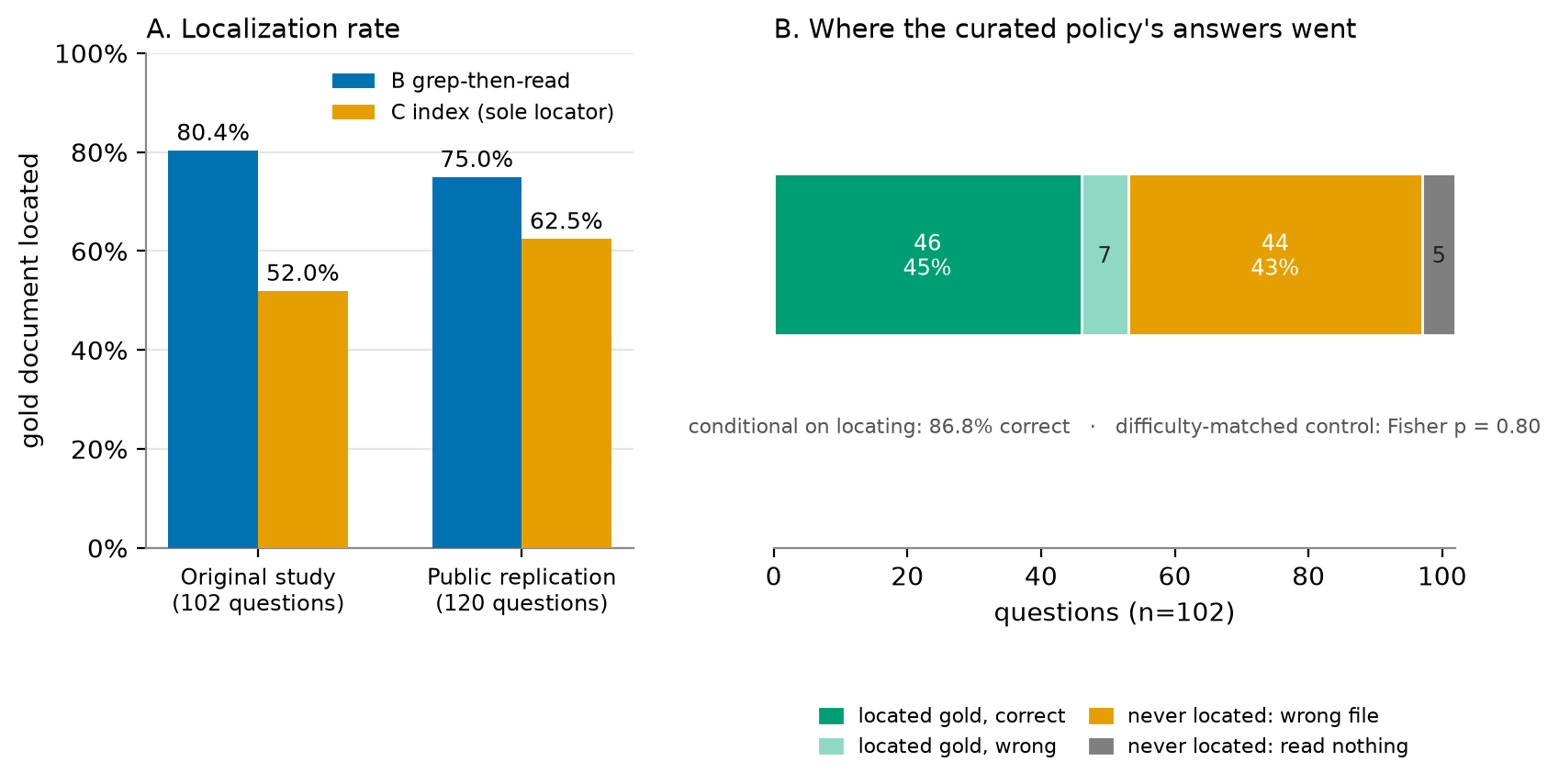
Figure 1. The anatomy of curated-retrieval failure under the sole-locator ablation. Left: localization rate (how often each policy brought the gold document into context) in the original study (B 80.4% vs C 52.0%, 102 questions) and the public replication (B 75.0% vs C 62.5%, 120 questions). Right: where the curated policy's 102 answers went in the original study: located the gold file and answered correctly (46); located it and answered wrong (7); never located it, having read a wrong file (44); never located it, having read nothing (5). Conditional on locating the file, C's accuracy is 86.8%; a difficulty-matched control on the oracle arm detects no answerability difference in the questions C failed to locate (Fisher p = 0.80; §4.2 states the interval). The deficit is localization.
| Policy | Accuracy | Error rate | Marginal tokens | Total tokens | of which cache reads |
|---|---|---|---|---|---|
| A flat-load (100k-char dump) | 2.9%† | 97.1% | 3.46M | 4.93M | 29.7% |
| B grep-then-read | 72.5% | 27.5% | 1.95M | 19.48M | 90.0% |
| C index-then-hydrate | 47.1% | 52.9% | 2.46M | 13.84M | 82.2% |
| D oracle-approx (gold file) | 82.4% | 17.6% | 0.68M | 2.13M | 67.9% |
† A is budget-bounded, not informative: its dump reached 4 of the 102 files, an attainable ceiling of 3.9% (§4.4).
Three columns here changed in a prior revision, all from quantities the
committed run records already carried. Error rate is added because the
abstract compared B and C on it while the paper reported only C's wrong-stop
rate, which is a subset of C's errors rather than C's error rate; the
apples-to-apples comparison is 27.5% against 52.9% (Fisher p = 0.0003), and it
is stronger than the frozen P3. The cache-read share is added because the
two token columns are not on a common price basis without it: marginal tokens
exclude cache reads, and cache reads are 90% of B's total against 30% of A's,
so the two columns rank the policies differently for reasons that have
nothing to do with policy. Marginal tokens are the policy-attributable
measure; totals are inflated by nested-CLI overhead that differs by arm, as
the committed harness notes at the point where it separates the components
(harness_lib.py:160–167). The cost column is withdrawn. Recorded
per-call cost_usd is provider-reported and we could not reproduce it from
list prices (reconstruction gives $4.79/$4.63/$4.77/$1.15 against the
recorded $7.32/$6.00/$6.49/$1.63), so "B is cheapest at $6.00" is not a claim
this table can carry. C's authoring cost stands separately at 1,307,300
generator tokens, reported amortized and unamortized in the effect table as
the frozen text requires.
| Frozen prediction | Threshold | Measured | Outcome |
|---|---|---|---|
| P1 accuracy parity | acc(B) ≥ acc(C) − 3pp | B +25.5pp above C | pass |
| P2 token order | tok(B) ≤ 2× tok(C), frozen on totals | 1.41× totals; 0.79× marginal | pass |
| P3 wrong-stop tax | C wrong-stop ≥ B wrong-answer | 46.1% vs 27.5% | pass‡ |
| P4 oracle headroom | B, C each ≥ 3× D; measure not frozen | totals 9.1×, 6.5×; marginal 2.85×, 3.60× | pass on totals, B fails on marginal |
| Refutation (C dominates) | >3pp better at ≤0.5× tokens | — | not triggered |
| Revision (search profligate) | P1 ∧ tok(B) > 5× tok(C) | 1.41× | not triggered |
‡ P3's registered form compares a subset to a superset; §4.3 gives the symmetric restatement (C 46.08% against B 12.75%), which is the reading to quote.
A defect in the method, disclosed. P2's frozen text names its measure ("B's total tokens ≤ 2× C's unamortized tokens"); P4's does not name one. Adjudicated on totals, P4 passes at 9.1× and 6.5×. Adjudicated on marginal tokens, B spends 1,948,295 against D's 683,496, which is 2.85×, and P4 fails for B. The recorded verdict is unaffected either way: C29's frozen falsification and revision triggers read only P1 and P2, so no P4 reading could have changed the verdict word. What the episode shows is therefore not a wrong choice but an underdetermined registration: the measure was chosen at adjudication time, which is exactly what a program whose contribution is mechanical adjudication against criteria fixed in advance must not allow, and this one allowed it. The rule is recorded for the program: freeze the measure with the threshold. One bound worth naming: D acquires an entire file of up to 60,000 characters while minimal sufficient context C*(τ) is typically far smaller, so measured policy/D ratios are lower bounds on headroom against true minimal sufficiency; the frozen bar was nonetheless set against D, and on marginal tokens it was not met. The oracle-headroom claim is reported hereafter as holding on totals only.
These outcomes are the result on this corpus. The released kit's public demonstrator falls below the frozen scored-question floor and adjudicates nothing (§8 Limits (b′)).
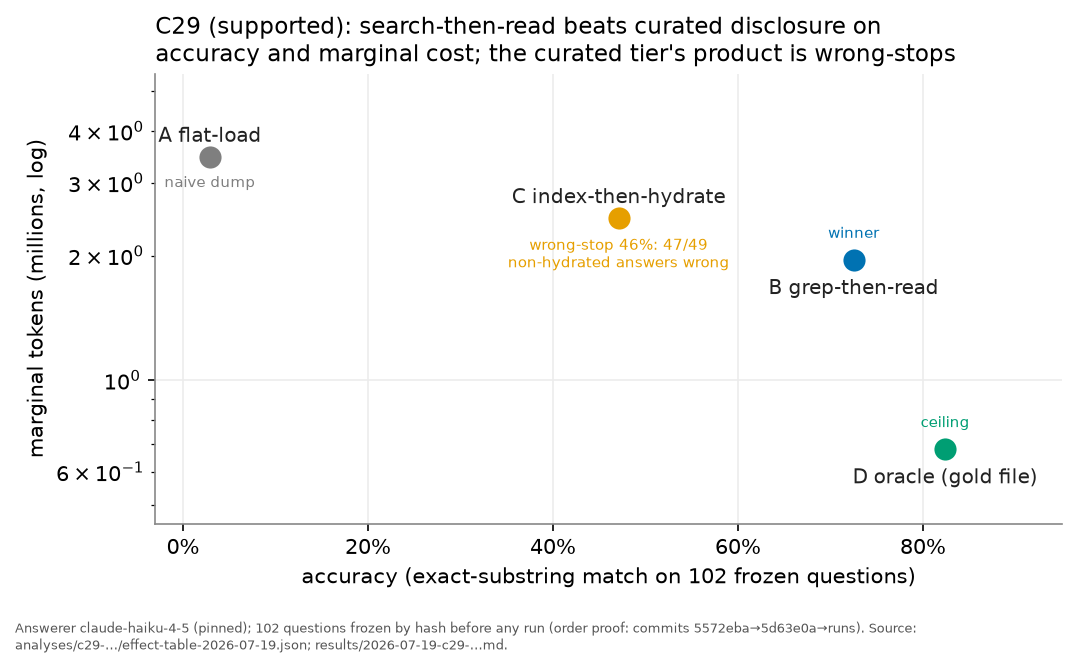
Figure 2. Accuracy vs. marginal token cost per retrieval policy (102 frozen questions, pinned answerer). Grep-then-read (B) is both more accurate and cheaper at the margin than curated index-then-hydrate (C). D is a minimal-sufficiency approximation at file granularity, not an upper bound: a subset of C exceeds it (see below). A is budget-bounded rather than informative: its 100,000-character dump reached only 4 of the 102 corpus files, so its attainable ceiling was 3.9%. C's position is paid for by mis-routing, not by early stopping. Measured on this corpus; the public demonstrator is below the frozen floor and adjudicates nothing (§8 Limits (b′)). The public replication (§5) reproduces B's accuracy and localization advantages on a releasable corpus at power (+12.5 pp; 75.0% vs 62.5% localization), and fails P4's headroom prediction on marginal tokens, the measure this paper's own disclosure said should have been frozen.
§4.1 Where C's accuracy goes
C answered 49 of 102 questions without ever reading the gold file, and 47 of those 49 were wrong (96%). An earlier draft read this as the policy trusting the digest and stopping. The run records say otherwise, and the reading is withdrawn. Of those 49 questions, only 5 involved reading no file at all; the other 44 read at least one file, the wrong one. Of the 47 wrong-stops, 43 read a wrong file and 4 read nothing. Against §2's construct (deciding from the digest alone), most flagged cases are not that: 43 of the 47 had hydrated a body, the wrong one, and only 4 acted on no body at all (3 of the replication's 41). The registered term wrong-stop is kept for continuity with the frozen predictions and is best read as an unhydrated-gold error rate; deciding from the summary alone is rare, and that rarity is itself the finding — the failure is mis-routing, not misplaced trust in digests. Over the full question set C issued 192 Read events to B's 174, a descriptive count, not a tested difference: under a Poisson comparison the gap is under one standard deviation, reads cluster within questions, and per §3's operational note search can consume content without a Read (the replication's counts run the same way, C 219 to B 189; pooled across both studies the gap is still short of significance, z ≈ 1.7). The mechanism claim does not rest on read volume; it rests on where the reads went. C located the gold file on 53 of 102 (52.0%) against B's 82 of 102 (80.4%). A policy that reads more and finds less is not stopping early. It is being mis-routed by its index. (The title names this observed pattern; the adjudicated finding is the localization gap, not the read-count difference.)
§4.2 The decomposition and the difficulty-matched control
Decomposing C by whether it located the gold file:
| C's behaviour | n | correct | accuracy |
|---|---|---|---|
| never read the gold file | 49 | 2 | 4.1% |
| read the gold file | 53 | 46 | 86.8% (Jeffreys 95% CI 75.8–93.9) |
| C overall | 102 | 48 | 47.1% |
Conditional on locating the file, C is not worse than B and, in the
original study, not worse than the oracle approximation (the replication's
matched subset runs even, 57 against 58, §5). But this conditioning is on
the outcome of the thing
under test: C's tool set is Read only (DESIGN.md D5), so the authored index
is C's sole locator, and "C when it read the body" is "C when the index worked."
The selection is nonetheless characterizable, and it is not question
difficulty. On the same 102 questions restricted to C's two subsets, D scores
43 of 53 (81.1%) where C located the file and 41 of 49 (83.7%) where it did not
(Fisher p = 0.80). The null is a failure to detect, not equivalence: the
95% interval on that difference (Newcombe score method) runs from −17.3 to
+12.6 pp, and the
control has little dynamic range this close to D's own 82.4% overall. Its
honest strength is proportion, not proof: the gap it would need to explain
is 82.7 pp (86.8% against 4.1%), and even the interval's unfavorable edge
accounts for about a fifth of that. The control itself is unregistered in
both studies: computed after adjudication, on known outcomes, descriptive
and adjudicating nothing, like every decomposition in §4.1–§4.5. B scores
42 of 53 (79.2%) and 32 of 49 (65.3%). C's deficit is a
localization deficit of the authored index, not a comprehension deficit and not
a stopping rule. Two corollaries. First, D is not a ceiling: on the matched
53, C scores 46 against D's 43, because there C holds the gold file plus the
index plus whatever else it read while D holds the gold file alone, truncated at
60,000 characters; the replication reverses the direction on its matched
75 (C 57 against D's 58), and neither difference is significant. The
original excess is not significant (McNemar exact p = 0.51), and
the frozen conjecture already declared D an approximation rather than true
optimality; only an earlier draft's prose called it a ceiling. Second, the
successor arm suggested by an early-stopping reading (index to locate, always
hydrate) is bounded by these data to at most the 5 zero-read questions, of
which 4 were wrong, giving a maximum attainable 51.0% and leaving B's margin
intact. The arm the data motivate is index-plus-search, and it is a future
pre-registration (§8).
§4.3 The symmetric comparison
A symmetric wrong-stop comparison, which frozen P3 does not make: P3 as registered compares C's wrong-stop rate to B's wrong-answer rate, a subset against a superset. Applying C's own frozen wrong-stop rule to B (incorrect and never read the gold file), B is 13 of 102 = 12.75% against C's 46.08%, a ratio of 3.6×. This is descriptive, not adjudicative, and it is a cleaner statement of the same phenomenon.
§4.4 Arm A is budget-bounded
Arm validation for A, owed and not previously given. Reconstructing the
flat-load prompt from the frozen manifest and the committed dump builder
(sorted-path order, 100,000-character budget), the dump reaches 4 of the 102
files, and the gold answer string is present in it for 4 of 102 questions.
A's attainable ceiling was 3.9%; it scored 3 of 102, which is 3 of the 4
questions it could possibly answer. The truncation was declared in DESIGN.md
D5 ("corpus exceeds it by design") but its magnitude was not reported, and an
earlier draft read A as informative about flat loading. It is not. A is a
budget-bounded baseline and supports no claim about flat loading, including
the "useless" characterization removed from Figure 2. P4's headroom claim does
not depend on A and is unaffected.
§4.5 Regime and language maps
Regime map (a report owed by the conjecture's registered limitations): B
beats C on lookup (72.8% vs 49.4%, n=81) and on synthesis (71.4% vs 38.1%,
n=21). One scope correction the design forces: the generator's synthesis
label is defined in its committed prompt as a question that "relates two
parts of the text" — two parts of one document — and every answer is an
exact substring of a single gold body, one question per file, so the
frozen claim's cross-file synthesis regime cannot occur in this question
set and remains untested (recorded in Limits (b)). What the map shows is
that the within-document synthesis label marks no regime shift. The
synthesis arm is underpowered at 21 questions and
carries correspondingly less weight than the lookup arm. Corpus-language
map, added because the demonstrator's non-reproduction was attributed to it:
on the paper's own 102 questions, B minus C is +29.4 pp on the 17 English
documents (B 12/17, C 7/17) and +24.7 pp on the 85 Spanish ones (B
62/85, C 41/85). The margin is larger on the English slice — but that
slice is the same 17 documents Limits (h) flags as observer-contaminated,
and n=17 carries little inferential weight on its own; the demonstrator's
tie is disposed of by its 19.0% power (Limits (b′)) regardless of this
map. Conjecture graduated to
corpus/supported/. Source:
results/2026-07-19-c29-curation-vs-search-sufficiency.md.
§5 The public replication at power (C34)
C29's evidence is 408 run records over a corpus that is 83% third-party
client material (85 of its 102 files, one question per file) and cannot be
released. C34 is the successor registered to fix that:
141 releasable documents selected by a frozen mechanical rule, snapshotted at
the byte, 120 confirmatory questions (one generated per document), the
same pinned answerer, three arms
(B, C and D; the flat-load arm exited after §4.4 showed it budget-bounded),
and three
criteria deliberately made harder than C29's. It was registered
2026-08-12, hours after the commissioned review that invalidated the
flat-load arm; the registration was corrected four times before the first
policy-run call (2026-08-13: treatment prompts pinned byte-verbatim,
factual fixes, degeneracy and index-leak annotations, a non-adjudicating
sensitivity table, none moving a threshold after data existed) and once
after (a bundle-copy redaction changing no threshold, prediction, scoring
rule or verdict); it ran and was adjudicated 2026-08-13/14. Registration
to verdict inside two days is a fact of the order proof, and the ordering
is carried by the commit chain (c34-study/ORDER-PROOF.md), not by the
calendar. The objection that ordering cannot answer — that a designer who
already knew the original result might choose a favorable corpus — is
answered by mechanism instead: rule R selected the 141 documents from all
154 candidates by frozen clauses, and its clause-level evaluation log
ships (c34-study/rule-R-evaluation-log.json). Rule R answers the
within-repository selection; the choice of the epistemics repository over
any other corpus in the estate was free, and is a scope condition, not a
mechanism. The three harder criteria named above are: a symmetric
wrong-stop rule, a token-headroom prediction frozen on marginal tokens
(the measure under which C29's own B would have failed), and an added
localization prediction. It was
registered before any harness code, corpus snapshot, question or provider call
existed.
| Frozen prediction | Threshold | Measured (120 questions/arm) | Outcome |
|---|---|---|---|
| P1 accuracy parity | acc(B) ≥ acc(C) − 3pp | B 63.3% (76/120) vs C 50.8% (61/120); +12.5pp | pass |
| P2 token order | total(B) ≤ 2× total(C) | 21.99M vs 16.94M | pass |
| P3′ wrong-stop tax, symmetric | wrong-stop(C) ≥ wrong-stop(B), identical rule | 34.2% vs 18.3% | pass |
| P4 oracle headroom, on marginal | B, C each ≥ 3× D, measure frozen | 1.84×, 2.73× (totals 7.56×, 5.82× would pass) | fail: the verdict's sole cause |
| P5 localization advantage | loc(B) > loc(C); ≥80% of pooled non-hydrated answers wrong, the frozen form | 75.0% vs 62.5%; pooled 84.0%, 63/75; curated arm 91.1%, 41/45 | pass |
Verdict: revised, machine reason
headroom_not_established_on_marginal_tokens; adjudicator replays
byte-identical; floors 120/120/120 scored; zero contamination findings
under the committed annotation scope (Limits (b) reports the whole-index
variant)
(results/2026-08-14-c34-public-curation-vs-search-replication.md,
shipped in the deposit as c34-study/RESULTS.md).
Two descriptive additions re-derive from the shipped run records
(committed data, no new adjudication; both recompute from
c34-study/runs/, whose 390 records are the three arms over the 120
confirmatory questions, 360, plus the excluded ten-question smoke set over
the same arms, 30; the shipped question file carries 141 questions, the
remaining 11 generated but never selected by the salted split and never
run, marked unused in the file). First, the anatomy replicates in public: of the
curated arm's 45 non-located questions, 42 had read a wrong file and 3 had
read nothing (C29: 43 and 4 of 47); conditional on locating the gold file,
the curated arm scored 76.0% (57 of 75); and the difficulty-matched
control transfers, with the oracle arm scoring 77.3% (58 of 75) on the
questions the index routed and 84.4% (38 of 45) on the questions it failed
to route (Fisher p = 0.48; Newcombe 95% interval −20.3 to +8.4 pp — a
failure to detect, bounded exactly as §4.2 bounds its C29 counterpart).
§4's headline contribution is
therefore re-derivable from public data, not only from the withheld C29
records. Second, P5's denominators, named: the frozen rule pools
non-hydrated answers across both arms (63 of 75 wrong, 84.0%);
arm-specific, the curated arm's non-hydrated answers were wrong on 41 of
45 (91.1%) and search's on 22 of 30 (73.3%). The pooled form is the
registered one; the arm-specific form is what the staked prediction's
"its" refers to, and it is the stronger of the two. Third, the index's
capacity and signal, measured (the replication figures re-runnable via
the shipped c34-study/digest_signal.py; the original study's index
figures are author-verifiable from its committed index file, per §Data's
verification asymmetry; the script's two rule parameters — content words
of four or more characters, a small bilingual stopword list — were fixed
on first computation and not tuned against the outcome). The resident index,
in the exact layout the curated prompt interpolates (path, dash, digest
per line), totals 30,223 characters (roughly 7.6K tokens); digest text
alone is 23,120 characters. The original study's committed index file
gives 24,163 and 17,668 (roughly 6.0K tokens). 53 of the 120 questions
(44%) share no content word with their own gold digest, and only 31
share two or more; questions whose gold digest carried at least one
question term were located by the curated arm on 71.6% (48 of 67),
against 50.9% (27 of 53) when it carried none (Fisher exact p = 0.024,
descriptive). One deflator is measured with it: of the ten questions
whose gold digest is storage-clipped at 200 characters, six are
zero-overlap, against 47 of 110 unclipped — a small-n elevation
consistent with clipping, not budget, inflating part of the zero-overlap
share. Stated at its correct strength: a crude lexical proxy for
digest signal predicts localization by +20.7 points — and 27 of the 53
zero-overlap questions were located anyway, so signal survives in
non-lexical forms for half of them. The direction matches the
body-resident-signal mechanism the skill-routing literature reports [47],
observed here on a document corpus. One projection is stated now, before
the budget successor registers, so it cannot be picked afterward: the
subgroup where the lexical mechanism is already satisfied localizes at
71.6%, below search's 75.0% on the same corpus — an estimate rather than
a bound, since lexically-traceable questions may differ systematically,
but it suggests raising the per-file budget closes part of the gap, not
all of it (the companion to §4.2's 51.0% bound on the always-hydrate
arm). The budget lever is also already partially exercised: the index
averages 164 characters against its 140-character instruction and still
localizes at 62.5%, independent support for reading 71.6% as near the
lexical channel's ceiling rather than its floor. On the
commensurability §4 established for token columns, C34's cache-read
shares are 91.0% of B's 21.99M total, 82.6% of C's 16.94M, and 62.9% of
D's 2.91M; the marginal-token absolutes, the measure that decided the
verdict, are B 1,989,121, C 2,941,951, D 1,079,014. Arm-D validation,
owed as §4.4's was for A: in this corpus no gold file's stripped body
exceeds the 60,000-character truncation and every gold answer lies within
it (0 of 120 affected), so the difficulty control does not conflate
answerability with file length. The same checks were run by the author on
the withheld original corpus (2026-08-16), under the frozen
normalized-substring rule, with each file first re-hashed against the
frozen manifest: 70 of the 102 files verify byte-exact today and 32 have
drifted since the 2026-07-18 freeze, the engagement's files having
continued to change — one more instance of Limits (g)'s lesson that
hash-freezing proves integrity, not availability. On the corpus as it
stands, two gold bodies exceed 60,000 characters (both among the drifted
files) and no gold answer lies beyond the truncation (0 of 102); the
6,000–8,000-character band holds 6 of the 102 answers (5 of the 70
byte-verified files). The frozen adjudication is untouched: C29's
evidence is its committed run records and hashes, not the corpus's later
state. Like all of §4, these checks are author-verifiable, not publicly
recomputable.
Three things follow, and the third is the one the program owes itself.
First, the curation-vs-search finding replicates on a corpus a reader can hold in full, at +12.5 pp rather than +25.5 pp: a smaller effect on a different corpus, in the same direction, under stricter rules.
Second, the symmetric wrong-stop rule vindicates the correction it encodes. C29's original P3 compared C's wrong-stop rate against B's wrong-answer rate, a subset against a superset. On C34's data that asymmetric form would have read C 34.2% against B 36.7%, making the curated index look better; the symmetric rule shows it wrong-stopping at nearly twice B's rate. The original comparison did not merely understate the tax. On this corpus it would have reversed the reading.
Third, the defect this paper disclosed above is exactly what failed. §4
recorded that P4's measure was not frozen and that the outcome flipped with
the choice, and set the rule: freeze the measure with the threshold. C34 did
so, chose marginal tokens (the harder reading, the one C29's B failed), and
P4 failed again, at 1.84× and 2.73× against the 3× bar. A prediction that fails
under a measure fixed in advance is a finding; the same prediction passing
under a measure chosen afterward would have been an artifact. The verdict word
is revised because of it, and the curation-vs-search answer is reported at
equal prominence beside that word rather than beneath it.
§6 The write-side result: promoted memory is rarely read back (C28)
The read-side result above has a write-side counterpart in the same
ecosystem, measured under the same discipline. C28 asked whether facts promoted into a
durable memory directory (the write-allocate policy of §2, and standard
practice in deployed agent harnesses) are ever read back.
corpus/refuted/c28-promotion-lane-returnability.md; predictions frozen at
the program registration (4b86195, 2026-07-18); adjudicated 2026-07-18 →
refuted.
Population per the frozen definition (≥30 days of post-creation corpus, ≥10
eligible same-project sessions): 157 files; the ≥100 floor passed. Measured:
2 of 157 files ever re-read (1.27%) against P1's ≥25%; median
eligible-session read rate 0.0% against P2's ≥1%. The frozen refutation
trigger (ever ≤10% AND median ≤10× T3) fired; the conjecture is refuted and
graduated to corpus/refuted/. The headline count is 2 of 157, on the
registered population; of the full 453-file corpus, the remaining 296 files had
not met the frozen eligibility rule and were not yet testable, and the claim
does not extend to them. The program's tier study reports 43 of
the same 453 objects as ever-exercised under a
looser frozen measure belonging to a different conjecture; the two numbers
describe the same files under two different frozen definitions and are never
pooled. The indexed-vs-orphan contrast (P3) read 2.25% (2 of 89 indexed) vs
0.0% (0 of 68 orphans). Mechanically this passes P3 as registered: the frozen
not-evaluable branch fires below 20 orphans and the corpus holds 68, so the
analyzer's recorded ratio (inf) clears the ≥3× bar. The pass carries no
information. The ratio is undefined at an orphan numerator of zero, the whole
contrast rests on two readers against none, and Fisher's exact test on the
2×2 table gives p = 0.51. It is reported because it was registered, and it
should be read as an untested prediction rather than a confirmed one. The
deeper defect is the adjudicator's: its not-evaluable branch guards the
orphan population (fires below 20), not the numerator, so a ratio
undefined at zero readers returned a mechanical pass that prose then had
to correct — human judgment at reporting time, which §7 exists to
preclude. The rule is registered for the program going forward: a rate
ratio whose denominator arm records zero events adjudicates as
not-evaluable. The frozen analyzer
stands as run.
Channel caveat, recorded and non-exculpatory: the registered limitations
declared that the tool-Read channel undercounts (index-only recall and harness
reminder injection are invisible to it) and accepted that bias as running
against P1/P2, so the refutation stands under the frozen terms; the analyzer
counted 18,780 non-tool mentions of memory files against 2 tool reads,
making injection-channel returnability a registrable successor. That successor
is now registered (c28b, registration commit 5cdebb9, 2026-07-22),
forward-adjudicated after its boundary and measured by channel-agnostic
content-fingerprint reuse; a feasibility probe first ruled out the
injection-event instrument, since the push channel is largely non-persisted;
its outcome is not anticipated here, and a refutation would generalize C28's
result to both channels. One recorded honesty note: the conjecture's single
motivating instance occurred in this program's own excluded session: the
example was the observer. Source:
results/2026-07-18-c28-promotion-lane-returnability.md.
Read together with §4, the two results point the same way: on the read path, the authored routing layer sends the agent to the wrong content; on the write path, the durably stored content is rarely routed to at all. Their evidential weights, however, are not comparable, and this paper does not average them. The read-side result rests on 408 committed run records and a powered public replication; the write-side result is a single tool-Read-channel measurement on a transcript corpus that no longer exists (§8 Limits (g)), with 18,780 non-tool mentions unadjudicated pending the registered c28b successor. The direction is convergent with published evidence on a different substrate: Yuan et al. find accuracy nearly insensitive to write strategy while retrieval dominates [12]. C28 stands as a frozen refuted verdict under its registered terms and channel caveat, no more and no less.
§7 The method as the instrument
Pre-registration of computing experiments is not new, and this paper does not
claim to import clinical norms into systems research: registered reports [27],
the HARKing analysis and preregistration protocol for CHI experiments [28], the
preregistration literature more broadly [29, 30], reproducibility programs at
ML venues [31], and per-method empirical standards for software engineering
[32] all predate it. What is offered as a contribution is the specific
combination, instantiated end to end: analyzers committed before their first
output; corpora frozen by content hash; the commit chain as order proof; retry
rules that never re-roll a scored answer; floors enforced even when the seen
estimates favored the registered predictions (twice); and seen estimates
permanently disqualified from justifying later floor changes. The program
scoreboard across its registered conjectures: one supported (C29, §4), one
refuted (C28, §6), one replication adjudicated revised under deliberately
harder criteria (C34, §5), and, in the program's tier study, two
instrument-insufficient probes whose estimates are on record and barred from
adjudicating anything.
One exhibit shows the discipline earning its keep, and it is restored here from the program's tier study because it argues for the method better than any passing result. The tier program's most prominent negative result (the recorded inversion in which searchable content out-returned pointer-resident content) was found by a post-hoc diagnostic to be substantially an edit-channel artifact: 73.5% of the searchable-tier objects were edited in-window against 9.5% of the pointer-tier files, 21 of 23 exercised searchable-tier files were exercised only by sessions that also wrote them, and with the channel excluded both tiers collapse toward zero, so the contrast stops being evaluable rather than reversing. The diagnostic then disclosed its own bound in the direction that mattered: running on the 341 surviving transcripts it recovers 70% of the frozen searchable-tier exercised files but only 26% of the pointer-tier ones (an under-recovery that flatters the deconfounded reading), and under the program's rules it amends no verdict and can justify no floor amendment. A program that finds the confound in its own headline negative result, quantifies it, and then reports that the quantification is biased toward its own correction is the concrete content of "the gauge, not the policy, is the deliverable." The full treatment is in the program's tier study (available on request); every load-bearing quantity from that exhibit appears above.
Two parts of that discipline are worth naming honestly. The adversarial reviews this manuscript was hardened against were commissioned by the author (2026-07-22 and 2026-08-12, dispositioned finding by finding in the research repository). C29 has survived an adversarial review that set out to refute it, and did not survive unchanged: the review correctly identified that the paper's public demonstrator fails the frozen P3, and prompted the decomposition that replaced an early-stopping account of §4's mechanism with mis-routing and invalidated the flat-load arm. But commissioned reviewers do not carry independent stakes, so the independent-stake condition is still unmet. Second, one refuted conjecture's motivating example was identified as observer contamination and recorded as such (§6); the same issue recurs for the 17 epistemics methodology documents, which serve simultaneously as C29's English arm, the public demonstrator's entire corpus, and measured objects in the program's tier probes. These are the documents in which this program was being written, during the window in which it measured them, by the operator whose behaviour is the unit of analysis. That is disclosed in Limits (h) rather than defended.
§8 Discussion, practice, and limits
What the anatomy licenses, and what it does not. The verdicts license no configuration change by themselves. Under the program's standing rule (no threshold is recommended before the data that would justify it exists), the two data-backed candidates are queued as future pre-registrations, each requiring its own frozen predictions and its own gauge before any behavior in the estate changes. The first candidate was once stated as "retiring digest authoring for greppable corpora." What C29 tested is an authored one-line-digest index used as a policy's sole locator, against grep as a sole locator; C had no search tool at all. The finding is that authored digests route worse than grep (52.0% against 80.4%), not that digests are worthless alongside grep, which was not tested. The candidate is re-scoped accordingly. The second candidate, redesigning or retiring the memory-promotion lane, rests on C28's refutation (§6) and is unaffected.
The arm not run, and why not running it is the method. The comparison a reader will ask for first is index-plus-search: the deployment-realistic arm in which the index is advisory and search remains available. That arm is unregistered. Running it now, on this corpus, with these questions, after these results, would be a post-hoc comparison of exactly the kind this program's discipline exists to preclude: its numbers would carry the appearance of adjudication with none of its guarantees, and the choice to run it would itself be conditioned on the outcomes reported above. The omission is deliberate. Index-plus-search is named as the registrable successor; its predictions will be frozen before any run; and its outcome, including the possibility that an advisory index recovers everything the sole-locator index loses, is not anticipated here. The successor family carries a second registered axis: the digest budget — whether localization crosses search's at some per-file budget above the instructed 140 characters — with the known point declared as known, §5's stated projection on the record, and every other point's outcome unanticipated. §4.2 bounds what these data can say about one member of that family (index-to-locate, always-hydrate: at most 51.0% on this corpus) and says nothing about the rest.
The capability confound, named as live. The divergence from Cochran's headline is not yet attributable. His preregistered ablation ran Claude Opus 4.8 and found curated access non-inferior on quality at 30–58% lower cost; this paper's pinned answerer is Haiku 4.5, a weaker tier, and the curated arm lost by 25.5 points. His discussion predicts the opposite interaction: "weaker agents should benefit more because they cannot route around a monolithic index" [39]. So capability alone, in his predicted direction, does not explain the two results. But the studies also differ in corpus, question generation, access design (his retrieval-tool arm against this paper's index-only C), and outcome instrument, so the confound is live, not resolved: what these two results jointly measure (indexes, or model tiers) is undetermined. Read-level decomposition at scale points the same way: across 16,758 coding-agent trajectories, 60–69% of capable models' failures reach the correct functions and fail afterward, so localization is not their binding stage [53]; whether §4's reach-bound regime persists as the answerer strengthens is exactly what the confound leaves open. The two-model arm is therefore not a follow-on but the decisive registered successor, and its outcome is not anticipated here.
C29's wrong-stop anatomy also measures a known failure mode in a new place: that models issue confident wrong answers rather than abstaining when their context is insufficient is established for retrieved context [26], and what §4 adds is the same failure measured against an authored digest tier, under pre-registration, with mis-routing rather than non-abstention as the dominant path.
Limits. (a) External validity: every measurement comes from one
single-operator ecosystem: one practitioner, one machine, one harness family;
portability is not demonstrated across operators. (b) C29 scope, from its results doc; the additions of 2026-08 are
post-hoc and marked: single-operator corpora with unusually
consistent naming (plausibly favors grep); auto-generated questions skew
locatable-fact (81 lookup / 21 synthesis; the split is reported and B wins
both); D approximates minimal-sufficiency at file granularity; one answerer
model at one capability tier (a stronger answerer might extract more from
digests) and — a post-hoc addition, descriptive — one writer-reader pair
(the digests were written by
claude-sonnet-5, a stronger model than the answerer that consumed them;
writer capability is an untested lever on routing quality, though one bias
runs against the reported deficit: the digest writer and the question
generator are the same model reading the same bodies, so shared salience
should push digests toward mentioning the queried facts, inflating C's
localization; the opposite bias is concrete and sized:
questions came from an 8,000-character prefix and digests from a
6,000-character one, so gold answers reachable at 8,000 characters but
not at 6,000 are structurally undescribable by any digest — under the
frozen normalized rule, 6 of the original study's 102 questions and 10 of
the replication's 120 (8.3%), each study sized on its own set. Question
guessability has a direct estimator in the correct-without-hydration
rate — 35% for search and 4.1% for the curated arm in the original study
(§3), 26.7% and 8.9% in the replication — an upper bound that mixes
guessability with content surfaced in search output; only 4 of the
replication's 12 correct-without-hydration answers carry a flagged
sub-three-word gold);
per the capability-confound paragraph above, the two-model arm is
the decisive registered successor, not assumed either way. Three further
scope conditions: C had no search tool (DESIGN.md D5), so the experiment
compares an authored index against grep as sole locators and says
nothing about an index used alongside search (§3's ablation defense and
the successor paragraph above); cross-file synthesis cannot occur in
either study's question set (one question per document, single-gold
substring answers) and is untested; and the tested C is a two-tier
realization (path plus a
one-line digest, then the full body), not the four-layer ladder the
conjecture text describes, a design choice recorded in DESIGN.md D1 before
the questions were generated.
Every one of these scope conditions survives into C34's public replication,
which shares the operator, the repository family, the answerer and the
harness lineage: what C34 buys is power, public re-runnability and a corpus a
reader can hold, not operator diversity, which remains the named next
successor. C34 adds one scope condition of its own, and it generalizes past
this program. Its question-generation prompt was byte-identical to C29's,
pinned precisely to keep the two comparable, and on the new corpus the same
prompt produced a 30% sub-three-word gold-answer rate against roughly 5% on
C29's, with three of 120 confirmatory golds so unspecific that the frozen
scoring rule could not fail them, a rate that also violates the generation
prompt's own 3–15-word instruction, so the defect is generator
non-compliance surfaced by the new corpus, not only corpus character. The
digest side carries the same class: the digest instruction's 140-character
cap was exceeded on 128 of 141 digests, 12 of them clipped at the
builder's 200-character storage cap (41 of 102 in the original study;
§3). Pinning a treatment string is necessary for
comparability and not sufficient for it: a replication that carries a
generator prompt onto a new corpus should measure the resulting question
set's discriminating power before spending its answering budget. C34 flags
the affected questions mechanically and reports two sensitivity analyses;
neither flips any prediction. An independent reproduction of the shipped
bundle (2026-08-15, DISPOSITION-2026-08-15.md) adds two measurement
caveats, disclosed at their measured size: the frozen scoring rule is
normalized substring containment with no word-boundary requirement, which
admits two genuine false positives on one question's eight-character hash
prefix (q073), symmetric across arms; and the committed index-leak
annotation is scoped to each gold file's own digest; under a whole-index
scope three further questions carry leaked gold strings (q023, q037, q120),
and on all three the curated arm answered wrongly having located nothing,
so the leak's direction remains against the reported result.
(b′) The public demonstrator. The released kit's demonstrator (16
questions over 17 English methodology documents;
repro-kit/DEMONSTRATOR-RESULT.md) adjudicates nothing: run against C29's
frozen criteria in the committed adjudicator's own order of operations, it
returns INSTRUMENT INSUFFICIENT (16 scored per policy against a floor of
100). Within that, frozen P3 fails and reverses (C's wrong-stop rate 18.75%
against B's wrong-answer rate 37.5%), and under the symmetric rule B and C
are identical at 3 of 16, with identical localization (12 of 16 each). At 16
questions per arm the two-sided Fisher power to detect the paper's own effect
is 19.0%, and B's 10 of 16 has a Jeffreys 95% interval of 38.3–82.6%,
which comfortably contains 72.5%, so the demonstrator provides no evidence
against the accuracy margin; it is uninformative about it. Nor is it an
external corpus: its 17 documents are the English half of C29's own corpus,
a subsample re-run by the same operator on the same machine, not a
replication. The language explanation an earlier draft offered is disposed by
§4.5: the margin is larger on the English slice of the paper's own
questions, so the demonstrator's tie differs by question sampling and
run-to-run variation at n≈16, not by corpus condition. Its record and
addendum stand unchanged and unretracted; its role in the public bundle is
filled by C34 (§5), registered for exactly this purpose. What the
demonstrator does support, at its true strength: the one qualitative pattern
visible in both runs is that C's non-hydrated answers are overwhelmingly
wrong (47 of 49 in the paper, 3 of 4 in the demonstrator).
(c) Definitional non-commensurability, by design: the program's frozen measures differ by conjecture (C28's post-creation return is not C29's localization), and cross-conjecture comparisons never pool them. (d) Tier-assignment ambiguity: objects straddle tiers (a skill is a T0 pointer plus a T1 body); assignment classifies access surfaces by committed analyzer rules. (e) What kills this paper's claims: an external replication in which an authored index used as sole locator localizes as well as or better than search would refute the staked prediction (§Invitation); the frame-level falsification criteria of the tier program travel with the program's tier study (available on request) and are unaffected by this text's narrower scope; the criteria a reader can hold this text to are the ones in this clause and the §Invitation prediction. The paper commits to publishing any such outcome as the result. (f) What this spine does not contain: no store-tier re-measurement (C7/C25 own that tier), no engine changes, no anticipated outcomes for the covered C26/C27 re-runs, the registered c26b/c28b successors, the index-plus-search successor, or the c30 candidate.
(g) The frozen transcript corpus no longer exists. Discovered during a
post-verdict diagnostic: 1,996 of the 2,337 transcripts in
analyses/shared/transcript-manifest-2026-07-18.json have been deleted from
disk. 341 survive, and all 341 verify byte-exact against their frozen prefix
hashes (none corrupted, none truncated). All 453 memory files, 102 workspace
files, and 251 skill files survive. This is clean deletion, almost certainly
harness transcript rotation, and it is not a data-integrity failure. It is
worse: it is a permanence failure. C28, and the program's two tier probes,
are no longer re-derivable from their
own manifests; their effect tables and results documents stand as the record,
and the inputs are gone. C29 is unaffected, because its evidence is its own
408 committed run records rather than the transcript corpus; C34 is unaffected
and fully re-runnable from its shipped bundle. The lesson generalizes and is
recorded for the program: hash-freezing proves integrity, not availability;
a manifest is not an archive.
(h) Observer contamination beyond the C28 instance. The 17 epistemics methodology documents serve simultaneously as C29's English arm, the public demonstrator's entire corpus, and measured objects in the program's tier probes, and they are the documents in which this program was written during the window it measured. The demonstrator role makes the public reproduction record non-independent (Limits (b′)).
§9 Related-work boundary
One dating note before the map: C29 was registered 2026-07-18 and adjudicated 2026-07-19. [40] first appeared two days after the registration, [54] and [60] in late July 2026, and [48] in August 2026: contemporaneous work this paper responds to, not prior art it overlooked. Cochran [39] appeared twelve days before the registration but was unknown to this program until an external audit surfaced it on 2026-08-14, a month after adjudication: the two designs specified the same read-level instrument independently, and his naming of that telemetry as a replication target was found after the fact. The boundary is drawn against the literature as of this text's date.
- Yuan et al. [12] (arXiv:2603.02473): diagnoses retrieval-versus- utilization bottlenecks in LLM agent memory and reports that "performance breakdowns most often manifest at the retrieval stage rather than at utilization," with accuracy spanning ~20 points across retrieval methods against 3–8 across write strategies, and raw chunked storage matching costly lossy alternatives. Occupies: the stage-attribution direction (the binding stage is retrieval) and a write-side insensitivity result that is convergent with §6's direction on a different substrate. Does not: the authored-digest substrate (its retrieval arms are retriever methods, not an authored index as sole locator), per-question read-level attribution, the mis-routing anatomy, or pre-registration. §4's conclusion is therefore convergent with published evidence at the stage level; what this paper claims is the substrate, the instrument, and the anatomy, not the direction.
- Cochran [39] (arXiv:2607.04576): a preregistered ablation of progressive disclosure on a frozen, LLM-maintained 709-page wiki, page bodies byte-identical across arms, in a 4×3 design whose enforced condition is read-only under a tool whitelist (agents attempted corpus-wide search on 39 of 320 enforced runs, all blocked). Finds targeted access cutting cost by roughly a third to a half with quality non-inferior within preregistered margins, and observes, in the unrestricted condition, capable agents bypassing the index by inferring page paths. Occupies: the preregistered disclosure ablation at scale, isolation by enforcement, the bypass observation, and the cost result. Does not: record the read level (the harness "recorded only aggregate usage," and the paper names direct read telemetry as a target for replication), so it has no localization rates, no wrong-stop decomposition, and no difficulty-matched control. The relation is complementary and explicit: §4 is, independently, the measurement Cochran's replication target describes, on a different corpus, with an opposite-signed headline whose candidate explanations §8 confronts (dating note above).
- He et al. [40] (arXiv:2607.17598): raw-document navigation and several Agent-Skills pack designs against a classical hybrid retriever across three agent harnesses; finds single-level disclosure sufficient, with added routing levels providing no benefit. Occupies: the disclosure-depth comparison across harnesses. Does not: sole-locator isolation, wrong-stop measurement, or pre-registration. Convergent with this paper's two-tier realization of C (D1) and with routing depth as a cost rather than a benefit.
- Sen et al. [41] (arXiv:2605.15184): grep against vector retrieval across agent harnesses; grep generally wins, harness-dependently. Occupies: the search-tool comparison inside harnesses. Does not: compare search against authored curation; the B-versus-C comparison of §4 is orthogonal to grep-versus-vector, and the two results compose rather than compete.
- Li et al. [43] (arXiv:2605.05242): direct corpus interaction (an agent searching a raw corpus with grep, file reads and lightweight scripts, no embedding model, vector index or retrieval API) against sparse, dense and reranking baselines, with trajectory-level coverage: a gold document counts as surfaced when it appears in the recorded trace as a retrieved snippet or as a file returned by a tool call. One vocabulary caution before any comparison: what this paper calls localization (whether the policy reached the gold document) maps to their coverage; their localization is a different, within-document quantity, how tightly a trajectory narrows to the evidence span inside an already-surfaced document. Two of their results bear here, and they come from different agents and samples. The win decomposition (DCI-Agent-CC, Sonnet 4.6 backbone, all 830 BrowseComp-Plus questions) parallels §4's failure decomposition: of 176 DCI wins over the retrieval agent, only 34 involve no gold document the baseline had surfaced. The lite-agent comparison (DCI-Agent-Lite, GPT-5.4 nano, a 100-question subset) wins by 28 points on accuracy with lower mean gold coverage than the embedding retriever (28.0 vs 56.7; coverage-any 70.0 vs 74.0). Their attribution is the mirror image of §4's: DCI's advantage "does not primarily come from surfacing more gold documents," with the largest gains in converting surfaced evidence into fine-grained local search and verification: post-reach resolution binds. In §4, reach binds: the curated arm's failures are overwhelmingly mis-routes (43 of 47), and where the index did route, comprehension held (86.8%). The two attributions are not in conflict once the designs are compared: their agent can always iterate, so a bad first hop is recoverable; C has no search tool, so a mis-route is terminal. Reach binds when there is no recovery path; post-reach resolution binds when there is. Which regime an advisory index sits in is exactly what the registered index-plus-search successor would discriminate (§8), and its outcome is not anticipated here. Occupies: per-question trajectory gold-reach on raw corpora, and the grep-versus-retriever comparison. Does not: authored curation anywhere in the design (no arm consults an authored digest index), and no pre-registration, no symmetric wrong-stop rule, no difficulty-matched control.
- Context-retrieval benchmarks: ContextBench [44] scores coding agents' explored context against human-annotated gold at file, AST-block and line granularity along the trajectory; its finding that substantial gaps separate explored from utilized context, with heavier scaffolding yielding only marginal retrieval gains, is the published cousin of §4's located-but-answered-wrong bucket; HippoCamp [45] scores evidence retrieval against ground-truth evidence file sets by file hit rate, recall and F1; SWE-Explore [58] scores repository exploration against line-level ground truth derived from solving trajectories, and CORE-Bench [59] benchmarks code retrieval for agentic coding at scale; file-level localization scoring is standard in issue-localization work descending from Agentless [35], e.g. OrcaLoca's File Match Rate and Function Match Rate [46]. Occupies: gold-reach instrumentation as benchmark infrastructure. Does not: point any of that instrumentation at an authored digest index over a document corpus.
- Agent-skill routing, the nearest occupied substrate. A skill registry under progressive disclosure is a set of authored one-line digests whose bodies are paged on demand: structurally, arm C's object class (there as elsewhere, "authored" names the maintained digest layer, not hand-writing, §3). SkillRouter [47] measures routing accuracy over ~80K skills and finds that hiding the body costs 37–44 pp, with body-distilled-description and metadata-only controls locating the missing signal in the body itself: the same sign as §4's deficit, at three orders of magnitude more digests, published nearly four months before C29's registration. Skill-Use [48] benchmarks skill use under progressive disclosure (the agent sees name and short description only and must retrieve the body) with a per-task trigger facet, and finds reliable triggering out of reach across eight models and two harnesses. More Skills, Worse Agents? [49] decomposes the degradation from growing an authored library into skill shadowing (wrong selection) against context overhead (right selection, degraded execution), a selection-versus-execution attribution adjacent to §4's located-versus-comprehension split. Occupies: authored-digest routing telemetry at scale, with controls this paper has no analogue for. Does not: a prose document corpus (skills are procedures with executable bodies, and routing failure surfaces as a wrong or missing tool invocation, not as a wrong-document answer delivered with full confidence); no oracle-arm difficulty control; no pre-registration; no wrong-stop rule.
- Opposite-signed and boundary results for indexes as locators. Code Isn't Memory [50]: a derived structural index of a codebase inside a coding agent yields a large within-harness localization gain over the same harness without it, and against a separate agentic-grep baseline claims non-regression at lower cost per solve, counter in sign to §4 on a different index class and corpus. The Library Theorem [51]: indexed external memory beats sequential scanning exponentially in theory and by 5× against near-optimal search in a controlled lookup experiment. Don't Retrieve, Navigate [52]: navigation over a distilled digest hierarchy beats flat retrieval on single-domain corpora with a recoverable taxonomy and loses on open-domain factoid pools, a boundary condition this paper's single-corpus-family data cannot test. Together these bound the staked prediction: it is a claim about one-line digests over a prose corpus used as a sole locator, not about indexes as a class (§8, §10); the operative contrast with [50] is index form and corpus (per-file prose digests against a structural code graph), not authorship, since this paper's digests are model-written (§3).
- SkillJuror [42] (arXiv:2606.11543): measures how the organization of skill packs changes runtime behavior. Occupies: resident-catalog organization effects. Adjacent to the configured-tier questions of the program's tier study; no return-rate measurement.
- MemGPT / Letta (arXiv:2310.08560): virtual context management: paging between a bounded window and external storage, driven by the model's own function calls. Occupies: window paging as architecture. Does not: measure utilization of what it pages, or validate staleness.
- MemOS (arXiv:2505.22101) and AIOS [33]: memory-as-OS at system scale. Occupies: the OS framing and lifecycle machinery. Does not: utilization measurement.
- Pichay (Mason, arXiv:2603.09023): demand paging for context windows; measures 21.8% structural waste inside windows across 857 sessions. Occupies: window-tier waste measurement and paging mechanics. Does not: tiers above/below the window.
- CoALA (arXiv:2309.02427): taxonomy of agent memory by content type. Orthogonal axis: CoALA classifies what kind of thing is remembered; the vocabulary of §2 classifies where it sits and what that position costs.
- Mei et al. (arXiv:2507.13334): the context-engineering survey; owns the term and the taxonomy of window-construction techniques. The window is the object of engineering; the substrate underneath is out of scope.
- ACE (arXiv:2510.04618): evolves the prompt payload itself. Engineers the resident content; does not address routing to anything outside it.
- Memory systems that fill the validation slot: MemoryBank [17], Mem0 [18], A-MEM [19], Generative Agents [20].
- Sufficient context [26]: formalizes whether retrieved context suffices to answer, independently of whether the answer is correct, and reports that strong models issue incorrect answers rather than abstaining when it does not. This is the nearest published statement of §2's minimal sufficient context C*(τ) and of §4's wrong-stop finding, and it is prior. What §4 adds is the same failure measured on an authored digest tier rather than a retrieval tier, pre-registered, with mis-routing rather than non-abstention as the dominant path. Anchored confabulation [56] sharpens the mechanism: partial evidence non-monotonically amplifies confident wrong answers, the direction in which §5's non-hydrated-wrong figures sit (91.1% on the curated arm; 84.0% pooled under the frozen rule).
- RAPTOR [34]: recursive abstractive summary trees over a corpus, retrieved at multiple levels. The operative difference is purpose and measurement, not hand versus machine (C29's digests are themselves model-written, §3): RAPTOR's layers are derived and optimized for retrieval quality, while C29's index is a maintained practice artifact whose committed prompt asks for exactly the routing artifact under test ("a one-line summary (max 140 characters) of what this document is and contains, useful for deciding whether to open it") and was never tuned against retrieval outcomes — no evaluation loop, no query set — and the measurement is wrong-stops and end-answer accuracy against an oracle approximation.
- Search-then-read sufficiency: Agentless [35] shows simple localize-then-repair matching or beating agentic machinery at repo scale, and SWE-agent [36] shows the search/read interface itself determining agent performance. The sufficiency of grep-then-read relative to elaborate machinery is an established empirical result, not one this paper introduces; the contribution here is the head-to-head against authored curation under pre-registration, with the index isolated as the router.
- Residency versus paging economics: CAG [37] and Xu et al. [38] compare preloading against retrieval on cost and accuracy. These are the A-versus-B comparison of §4 in the published literature. Neither has a curated-tier arm, neither measures wrong-stops, and neither is pre-registered.
Three claims this leaves unoccupied, each stated at the granularity that survives the closest published neighbor:
- The document-corpus anatomy of authored curation, with an oracle difficulty control. Scoring gold-reach is not new at any level: retrieval evaluation scores a retriever's returned set against a labelled gold set (recall@k is the standard instrument), Yuan et al. measure retrieval relevance at the retriever boundary [12], the agentic-retrieval literature scores trajectory-level gold coverage of an agent's own tool-call reads on raw corpora [43], context-retrieval benchmarks score explored context against annotated gold [44, 45, 58, 59], and the skill-routing literature points routing telemetry at authored digest layers at scale [47, 48, 49]. Nor is the deficit's direction new: SkillRouter's 37–44 pp body-hiding cost carries the same sign, at larger scale, nearly four months before C29's registration [47]. What this paper contributes on that occupied map is the document-corpus instantiation with an attribution its neighbors do not carry: a prose corpus whose authored one-line-digest index is the policy's sole locator; per-question read-level telemetry on that arm; the decomposition of failure into located/mis-routed/unread (43 of 47 wrong-stops had read a wrong file; conditional-on-routing accuracy 86.8% original, 76.0% replication); and a difficulty-matched control on an oracle arm detecting no answerability difference in the failed questions (Fisher p = 0.80; §4.2 states the interval; post-hoc descriptive in both studies, §4.2); the nearest analogue we found to that control is Agent Retrieval Bench's no-gold and wrong-repository conditions [54], which control for presence, not difficulty. A convergence, an anatomy, and a control: the claim is staked on this substrate, not on the instrument class [43, 44, 45] and not on the isolation, which Cochran's enforced arm also achieves [39].
- The demonstrated wrong-stop reversal. Measuring both arms under one wrong-stop rule is a correctness requirement, not a discovery, and the contribution class (showing that the scoring rule, not the system, decides the winner) is occupied: Same Ranking, Different Winner flips agent-memory benchmark conclusions on 83.4–94.0% of shared queries by switching only the credited target over fixed outputs [55]. What this paper adds is the class instantiated on a curated-versus-search comparison: under the rule the original study registered, C34's data would have reversed the reading (§5). Neighboring ablations that score "answered without the right content" asymmetrically can check their own comparisons against this case.
- Mechanical adjudication with byte-identical re-derivation. Pre-registration by itself is not rare here: Cochran registered on OSF with a citable DOI (10.17605/OSF.IO/FEKA7), registration provenance stronger than this paper's private git chain [39]. What remains rare is the pair this deposit ships: a verdict produced by a committed adjudicator with no human judgment at adjudication time, and a bundle from which every number in §5 re-derives byte-identically, test suite included. The claim is that pair, not the registration.
Data & artifact availability
Citation convention. Repository-relative paths in this paper (e.g.
results/2026-07-18-c28-…, analyses/…/effect-table-2026-07-19.json) refer to
files in the epistemics research artifact. The order proof for every
pre-registered claim is the git commit chain, timestamped and append-only:
program registration 4b86195 (predictions frozen); the C29 harness and design
5572eba preceding the frozen, hashed question set 5d63e0a
(sha256[:16] 8f39408f324ffb84) preceding the first policy run; the C29 verdict
dc5bfca. A reviewer verifies the ordering from the commit metadata without
access to any withheld content; the deposit ships that chain as
c34-study/ORDER-PROOF.md (commit hashes, author timestamps and subjects
for the registration, freeze, run and verdict commits), so a bundle-only
reader can check the ordering without the repository, whose history remains
the authority. One verification asymmetry is stated plainly: C29's raw run
records are withheld with its client corpus (see Confidentiality below), so
§4 is checkable for internal consistency and against committed hashes,
while §5 re-derives from shipped data byte for byte.
Canonical public record. This paper's deposit is DOI 10.5281/zenodo.21960138 (Zenodo); the concept DOI 10.5281/zenodo.21938412 resolves to the current version. Cite this version DOI, not the concept DOI, which is a moving pointer. The repository-relative paths below resolve inside the deposited bundle.
The C34 public bundle. The public replication ships in full and
is the artifact a reader should start from: the 141-document corpus snapshot at
the byte with per-file hashes, the rule-R evaluation log accounting for all 154
candidates with the clause that accepted or rejected each, the 141 frozen
questions with gold answers, the salted
confirmatory/smoke split, the authored index and the two frozen prompt
strings that produced questions and digests (committed in
generate_questions.py, byte-compared against the registration by
test_prompts_frozen.py), all 390 run records and per-attempt
logs, the smoke audit, the effect table, the dated results document, the full
registration chain including every correction, and the harness, adjudicator and
test suite. Re-running adjudicate.py reproduces the committed effect table
byte for byte; the bundle's own test suite runs from a plain directory.
One redaction, registered rather than silent: the corpus-selection rule
excludes files mentioning third-party client identifiers, and that token list is
a curated enumeration of exactly those identifiers, three of them personal names
of people not party to this study. The bundle ships the rule with the list
emptied and the sha256 of the canonical list alongside, so anyone holding the
original can prove in one line that it is the same rule; the rule's effect
(which files were rejected, by which clause, with hit counts) ships in full. The
enumeration is in any case not re-runnable from the bundle, because it reads the
epistemics git tree at cb73654 and no git history ships. Registered in
instruments/2026-08-14-c34-registration-correction-v5.md.
Confidentiality boundary. One corpus in the C29 experiment (Workspace-P) is
a third-party client engagement; its documents, the derived question set, the
digest index, and the per-run answer records contain verbatim client
operational content and are withheld. The audit of exactly what is and is
not exposed is SENSITIVITY-AUDIT.md: the paper's prose, the effect
tables, and the cited results documents carry no client content; the raw
C29 data does. One transmission fact belongs here rather than left
implicit: the measurement's provider calls carried client content to the
model provider — frontmatter-stripped bodies as 6,000- and 8,000-character
prefixes during digest and question generation, and whole documents during
the 408 policy runs (search's full reads, the curated arm's hydrations,
and the oracle arm's gold files of up to 60,000 characters) — together
with derived questions and answers. That is the same provider, harness and
account that process the engagement's own working sessions, so the
measurement introduced no new receiving party; session persistence was
disabled throughout. That audit document is itself repository-internal by its own
header (it enumerates the withheld identifiers, so shipping it would
disclose what it protects) and it therefore stays out of the deposit. No part of the client corpus is released with this paper. The
epistemics repository itself is not published: client content sits in its
committed git history, so no release here can take the form of publishing the
repository. Artifacts are released individually: the paper, its figures, and
repro-kit/ publicly, and anything else only under appropriate
confidentiality terms.
Release shape. The reproducibility package (repro-kit/) contains the
harness, the 17 operator-owned English methodology documents as a public
corpus, a public question set frozen by hash before its runs
(820352e5b0b4b147), and a reference demonstrator result
(repro-kit/DEMONSTRATOR-RESULT.md). Two things must be said about that
demonstrator wherever it is cited. Its 17 documents are the English half of
the paper's own C29 corpus, so it is a subsample re-run by the same operator
on the same machine, not an independent replication. And at 16 questions per arm
it falls below C29's frozen 100-question floor, so under the committed
adjudicator it returns INSTRUMENT INSUFFICIENT and adjudicates nothing; within
that, frozen P3 fails and reverses. Both are set out in §8 Limits (b′). The full
102-question result stands on the committed hashes of the withheld set; the
private artifacts are available under appropriate confidentiality terms. Note
also, per §8 Limits (g), that the transcript corpus underlying C28 and the
program's tier probes no longer exists on disk, so those probes cannot
be re-derived by anyone, including the author.
Invitation to replicate. The single-operator scope (§8 Limits) is this
paper's sharpest external-validity bound, and the kit is its intended remedy:
repro-kit/repro_kit.py runs the full A/B/C/D comparison end-to-end on any
operator's markdown corpus with pinned models and a deterministic
adjudicator (the kit retains arm A for comparability with the original
study; the replication retired it, §5).
We explicitly invite replications, confirming or refuting, and will link
external results from the artifact repository. Two conditions on any such
run, learned from our own. Report the scored-question count against C29's
frozen floor of 100 per policy: below it the frozen adjudicator returns
instrument-insufficient, and a 16-question run has roughly 19% power against the
effect reported here. And record, per question, whether the policy read the gold
file, because that single field is what separates the two mechanisms this paper
had to distinguish (mis-routing from early stopping) and it is what we found
an earlier draft had misread in its own data.
The prediction we stake on replication, scoped to its substrate: an authored one-line-digest index (model-written under a fixed operator prompt instructing at most 140 characters per file, observed up to 200, §3) over a prose document corpus, used as a policy's sole locator, will route to the correct document less often than associative search over the same corpus, and, under the same unhydrated-error rule applied to both arms, the curated arm's non-hydrated answers will be wrong more often than search's (96% against 65% in the original study; 91.1% against 73.3% in the replication) — the differential, not the level, is the falsifiable quantity, since exact-substring answers produced without the source are mostly wrong for any arm. The scope condition is not decoration; on other index classes the published sign differs: a derived structural code index shows a within-harness localization gain and non-regression against agentic grep [50], indexed lookup beats even near-optimal sequential search outright [51], and digest hierarchies win precisely where the corpus taxonomy is recoverable [52]. We do not stake the accuracy margin, which is corpus- and question-set-dependent; and we do not stake "the wrong-stop mechanism" in those words, because our own public demonstrator shows no wrong-stop tax at all once B is measured under the same rule as C.
Acknowledgements and lineage
The conceptual object this paper's vocabulary formalizes was not invented
here. The "progressive disclosure" and "epistemic handle" ideas, and the
framing of memory as active infrastructure, come from a 2025 design corpus
(the mentu-finder and Epistemic-Science-&-Engineering notes) and a founding
"CIR — memory as infrastructure" specification (2025-06); this paper's
contribution is to de-brand those ideas into measured tiers and policies and to
subject them to falsification. The store-tier return baseline (0.0222%) is
prior work in the same repository (paper/return-base-rate-paper.md). The
method (conjectures with frozen predictions, mechanical adjudication, refuted
claims retained) is the standing constitution of the epistemics corpus and
follows its sibling papers on evidence-carrying execution and structural waste.
The cross-camp reference seed was assembled during an earlier documentation
audit of the same estate. Per the repository's authorship convention, the
author is sole author and committer.
References
Verification: references 1–8 were verified against their primary sources
(arXiv abstract pages; publisher/index records for the two classical entries)
on 2026-07-22; references 10–13 were verified against their arXiv abstract
pages on 2026-07-23 (added after an external adversarial review surfaced them
as prior art); references 14–38 were verified on 2026-08-12, the arXiv entries
against the arXiv API (title, full author list, v1 date) and the non-arXiv
entries against Crossref (title, container, volume, pages, DOI); references
39–42 were added after an external audit (2026-08-14) surfaced them as the
closest contemporaneous neighbors, and were verified against their arXiv
abstract pages on 2026-08-14; references 43–46 were added after a further
external audit (2026-08-15) surfaced the instrumented-retrieval neighbors,
and were verified on 2026-08-15 against their arXiv abstract pages, with the
coverage definition, metric vocabulary, per-agent attribution and
win-decomposition statistics of [43] checked against its full text;
references 47–61 were added after a further external audit paired with an
independent reproduction report (both 2026-08-15, dispositioned
finding by finding in DISPOSITION-2026-08-15.md), and were verified on
2026-08-15 against the arXiv API (title, author list, v1 date), with the
load-bearing quantities of [47], [50], [51], [52], [53], [54], [55], [56],
[60] and [61] checked against their abstracts or full texts. Two
parenthetical author counts in the 14–38 range ([5], [32]) did not survive
re-verification against the live API (author lists drift across arXiv
versions) and are removed rather than re-pinned; the four-round
artifact-consistency audit of 2026-08-16 touched no reference entry, and
its rounds are dispositioned in the repository's dated disposition
documents (the provenance note tallies the full series: two commissioned
reviews, then seven audits). Every
reference resolved. Full BibTeX:
references.bib.
Reference 9 is a live public documentation page and is the one entry in this list that cannot be retroactively verified by any party, including the author: a live URL with an access date carries no version a reader can pin. It supports the policy-push injection channel (§2); it should be read as unchecked. Replacing it with a dated archival capture or a documentation-repository commit is an open item, recorded rather than performed here.
- L. Mei et al. A Survey of Context Engineering for Large Language Models. arXiv:2507.13334, 2025. Framing anchor (§9).
- Q. Zhang et al. Agentic Context Engineering: Evolving Contexts for Self-Improving Language Models. arXiv:2510.04618, ICLR 2026. Nearest payload-evolution rival (§9).
- T. Mason. The Missing Memory Hierarchy: Demand Paging for LLM Context Windows (Pichay). arXiv:2603.09023, 2026. Window-tier paging and the 21.8% structural-waste measurement (§9).
- C. Packer, S. Wooders, K. Lin, V. Fang, S. G. Patil, I. Stoica, and J. E. Gonzalez. MemGPT: Towards LLMs as Operating Systems. arXiv:2310.08560, 2023. Virtual context management (§9).
- Z. Li et al. MemOS: An Operating System for Memory-Augmented Generation (MAG) in Large Language Models. arXiv:2505.22101, 2025. Memory-as-OS at system scale (§9).
- T. R. Sumers, S. Yao, K. Narasimhan, and T. L. Griffiths. Cognitive Architectures for Language Agents (CoALA). arXiv:2309.02427; TMLR, 2024. Content-type memory taxonomy, the orthogonal axis (§9).
- R. A. Howard. Information Value Theory. IEEE Trans. Systems Science and Cybernetics, SSC-2(1):22–26, 1966. doi:10.1109/TSSC.1966.300074. Value-of-information lineage (§2).
- M. L. Weitzman. Optimal Search for the Best Alternative. Econometrica, 47(3):641–654, 1979. Search with inspection costs; imported as metrics, not as a transferable optimality theorem (§2).
- Anthropic. Claude Code hooks reference.
code.claude.com/docs/en/hooks, accessed 2026-07-22. The public hook API cited for the policy-push injection channel (§2). - W. Chatlatanagulchai, H. Li, Y. Kashiwa, B. Reid, K. Thonglek, P. Leelaprute, A. Rungsawang, B. Manaskasemsak, B. Adams, A. E. Hassan, H. Iida. Agent READMEs: An Empirical Study of Context Files for Agentic Coding. arXiv:2511.12884, 2025. Large-scale census (2,303 files) of the configured tier's composition (§1).
- T. Gloaguen, N. Mündler, M. Müller, V. Raychev, M. Vechev. Evaluating AGENTS.md: Are Repository-Level Context Files Helpful for Coding Agents? arXiv:2602.11988, 2026. Measures the boot tier's task utility; finds it frequently unhelpful at >20% added cost (the program's tier study, §6.1 there).
- B. Yuan, Y. Su, K. Yao. Diagnosing Retrieval vs. Utilization Bottlenecks in LLM Agent Memory. arXiv:2603.02473, 2026. Separates retrieval from utilization; finds retrieval dominant (§9).
- X. Long, Z. Chen, S. Zeng, S. Wang, K. Guo, J. Tang. MemTrace: Probing What Final Accuracy Misses in Long-Term Memory. arXiv:2606.17328, 2026. Per-knowledge-point memory probing (§9).
- A. J. Smith. Cache Memories. ACM Computing Surveys 14(3):473-530, 1982. doi:10.1145/356887.356892. Fetch, placement, replacement, and write axes; the lineage of §2's policy names.
- P. J. Denning. Virtual Memory. ACM Computing Surveys 2(3):153-189, 1970. doi:10.1145/356571.356573. Cited in §2.
- P. J. Denning. The working set model for program behavior. Communications of the ACM 11(5):323-333, 1968. doi:10.1145/363095.363141. The direct ancestor of "what should be resident before the task arrives" (§2).
- W. Zhong, L. Guo, Q. Gao, H. Ye, Y. Wang. MemoryBank: Enhancing Large Language Models with Long-Term Memory. arXiv:2305.10250, 2023. Ebbinghaus-inspired decay and reinforcement (§9).
- P. Chhikara, D. Khant, S. Aryan, T. Singh, D. Yadav. Mem0: Building Production-Ready AI Agents with Scalable Long-Term Memory. arXiv:2504.19413, 2025. Extraction plus consolidation over stored items (§9).
- W. Xu, Z. Liang, K. Mei, H. Gao, J. Tan, Y. Zhang. A-MEM: Agentic Memory for LLM Agents. arXiv:2502.12110, 2025. Link evolution and memory update as new items arrive (§9).
- J. S. Park, J. C. O'Brien, C. J. Cai, M. R. Morris, P. Liang, M. S. Bernstein. Generative Agents: Interactive Simulacra of Human Behavior. arXiv:2304.03442, 2023. Recency, importance, and relevance retrieval scoring plus reflection (§9).
- N. F. Liu, K. Lin, J. Hewitt, A. Paranjape, M. Bevilacqua, F. Petroni, P. Liang. Lost in the Middle: How Language Models Use Long Contexts. Transactions of the ACL 12:157-173, 2024. doi:10.1162/tacl_a_00638. The attention-tax premise (the program's tier study, §4.1 there).
- M. Levy, A. Jacoby, Y. Goldberg. Same Task, More Tokens: the Impact of Input Length on the Reasoning Performance of Large Language Models. arXiv:2402.14848, ACL 2024. Length degradation at fixed task (the program's tier study).
- Y. Chang, K. Lo, T. Goyal, M. Iyyer. BooookScore: A systematic exploration of book-length summarization in the era of LLMs. arXiv:2310.00785, ICLR 2024. Measured fidelity failures in hierarchically merged summaries; the lossy-digest premise (§2).
- E. Aghajani, C. Nagy, O. L. Vega-Márquez, M. Linares-Vásquez, L. Moreno, G. Bavota, M. Lanza. Software Documentation Issues Unveiled. Proc. ICSE 2019, pp. 1199-1210. doi:10.1109/icse.2019.00122. (The program's tier study.)
- E. Aghajani, C. Nagy, M. Linares-Vásquez, L. Moreno, G. Bavota, M. Lanza, D. C. Shepherd. Software Documentation: The Practitioners' Perspective. Proc. ICSE 2020, pp. 590-601. doi:10.1145/3377811.3380405. (The program's tier study.)
- H. Joren, J. Zhang, C.-S. Ferng, D.-C. Juan, A. Taly, C. Rashtchian. Sufficient Context: A New Lens on Retrieval Augmented Generation Systems. arXiv:2411.06037, ICLR 2025. Sufficient context and confident non-abstention; prior art for §2's C*(τ) and §4's wrong-stop framing (§8, §9).
- C. D. Chambers. Registered Reports: A new publishing initiative at Cortex. Cortex 49(3):609-610, 2013. doi:10.1016/j.cortex.2012.12.016. Cited in §7.
- A. Cockburn, C. Gutwin, A. Dix. HARK No More: On the Preregistration of CHI Experiments. Proc. CHI 2018, pp. 1-12. doi:10.1145/3173574.3173715. Pre-registration of computing experiments with explicit HARKing analysis (§7).
- B. A. Nosek, C. R. Ebersole, A. C. DeHaven, D. T. Mellor. The preregistration revolution. PNAS 115(11):2600-2606, 2018. doi:10.1073/pnas.1708274114. Cited in §7.
- J. P. A. Ioannidis. Why Most Published Research Findings Are False. PLoS Medicine 2(8):e124, 2005. doi:10.1371/journal.pmed.0020124. Cited in §7.
- J. Pineau, P. Vincent-Lamarre, K. Sinha, V. Larivière, A. Beygelzimer, F. d'Alché-Buc, E. Fox, H. Larochelle. Improving Reproducibility in Machine Learning Research (A Report from the NeurIPS 2019 Reproducibility Program). arXiv:2003.12206, 2020. Cited in §7.
- P. Ralph et al. Empirical Standards for Software Engineering Research. arXiv:2010.03525, 2020. Per-method reporting standards including registered reports (§7).
- K. Mei, X. Zhu, W. Xu, W. Hua, M. Jin, Z. Li, S. Xu, R. Ye, Y. Ge, Y. Zhang. AIOS: LLM Agent Operating System. arXiv:2403.16971, 2024. A second OS-framing system alongside MemOS (§9). Note: first author Kai Mei, distinct from reference 1's L. Mei.
- P. Sarthi, S. Abdullah, A. Tuli, S. Khanna, A. Goldie, C. D. Manning. RAPTOR: Recursive Abstractive Processing for Tree-Organized Retrieval. arXiv:2401.18059, ICLR 2024. Derived rather than authored layers (§9).
- C. S. Xia, Y. Deng, S. Dunn, L. Zhang. Agentless: Demystifying LLM-based Software Engineering Agents. arXiv:2407.01489, 2024. Cited in §9.
- J. Yang, C. E. Jimenez, A. Wettig, K. Lieret, S. Yao, K. Narasimhan, O. Press. SWE-agent: Agent-Computer Interfaces Enable Automated Software Engineering. arXiv:2405.15793, 2024. Cited in §9.
- B. J. Chan, C.-T. Chen, J.-H. Cheng, H.-H. Huang. Don't Do RAG: When Cache-Augmented Generation is All You Need for Knowledge Tasks. arXiv:2412.15605, 2024. Content residency versus retrieval, priced (§9).
- P. Xu, W. Ping, X. Wu, L. McAfee, C. Zhu, Z. Liu, S. Subramanian, E. Bakhturina, M. Shoeybi, B. Catanzaro. Retrieval meets Long Context Large Language Models. arXiv:2310.03025, 2023. Cited in §9.
- T. O. Cochran. Progressive Disclosure for LLM-Maintained Wiki Knowledge Bases: a Preregistered Ablation. arXiv:2607.04576, 2026. Preregistered disclosure ablation on a frozen 709-page wiki; observes agents bypassing the index via path inference (§1, §3, §9).
- Y. He, Y. Zhao, J. Wang, H. Chen. Is Progressive Disclosure All You Need for Long-Context Agents? arXiv:2607.17598, 2026. Disclosure designs against a hybrid retriever across three harnesses (§1, §9).
- S. Sen, A. Kasturi, E. Lumer, A. Gulati, V. K. Subbiah. Is Grep All You Need? How Agent Harnesses Reshape Agentic Search. arXiv:2605.15184, 2026. Grep against vector retrieval across harnesses (§1, §9).
- Z. Chen, Z. Guo, B. Huang, B. Lu, J. Lin, Y. Zhou, W. Zhang. SkillJuror: Measuring How Agent Skill Organization Changes Runtime Behavior. arXiv:2606.11543, 2026. Skill-pack organization effects at runtime (§1, §9).
- Z. Li, H. Zhang, C. Wei, P. Lu, P. Nie, Y. Lu, Y. Bai, S. Feng, H. Zhu, M. Zhong, Y. Zhang, J. Xie, Y. Choi, J. Zou, J. Han, W. Chen, J. Lin, D. Jiang, Y. Zhang. Beyond Semantic Similarity: Rethinking Retrieval for Agentic Search via Direct Corpus Interaction. arXiv:2605.05242, 2026. Trajectory-level gold coverage for direct corpus interaction (§1, §9).
- H. Li, L. Zhu, B. Zhang, R. Feng, J. Wang, Y. Pan, E. T. Barr, F. Sarro, Z. Chu, H. Ye. ContextBench: A Benchmark for Context Retrieval in Coding Agents. arXiv:2602.05892, 2026. Explored context scored against annotated gold at file, AST-block and line granularity (§1, §9).
- Z. Yang, S. Tian, K. Hu, S. Liu, H.-N. Nguyen, Y. Zhang, Z. Guo, M. Yu, Z. Zhang, J. Yang, C. C. Loy, Z. Liu. HippoCamp: Benchmarking Contextual Agents on Personal Computers. arXiv:2604.01221, 2026. Evidence retrieval scored against ground-truth evidence files (§1, §9).
- Z. Yu, H. Zhang, Y. Zhao, H. Huang, M. Yao, K. Ding, J. Zhao. OrcaLoca: An LLM Agent Framework for Software Issue Localization. arXiv:2502.00350, 2025. File Match Rate and Function Match Rate as localization metrics (§9).
- Y. Zheng, Z. Zhang, C. Ma, Y. Yu, J. Zhu, Y. Wu, T. Xu, B. Dong, H. Zhu, R. Huang, G. Yu. SkillRouter: Skill Routing for LLM Agents at Scale. arXiv:2603.22455, 2026. Routing accuracy over ~80K authored skill digests; hiding the body costs 37–44 pp (§1, §9).
- J. Han, Y. Xu, Y. Liao, X. Wang, Z. Jiang, Z. Di, F. Lu, Z. Hu, Y. Xiao. Skill-Use: Can LLMs Actually Use Skills in Agentic Harnesses? arXiv:2608.04828, 2026. Skill use under progressive disclosure; per-task trigger telemetry (§1, §9).
- H. Song, S. Wei. More Skills, Worse Agents? Skill Shadowing Degrades Performance When Expanding Skill Libraries. arXiv:2605.24050, 2026. Skill shadowing against context overhead as a selection-versus-execution decomposition (§9).
- I. Bhola, A. Krishnan, S. Kurmala, M. NS. Code Isn't Memory: A Structural Codebase Index Inside a Coding Agent. arXiv:2606.22417, 2026. Structural code index: within-harness localization gain; non-regression against agentic grep (§9).
- Z. F. Mainen. The Library Theorem: How External Organization Governs Agentic Reasoning Capacity. arXiv:2603.21272, 2026. Indexed external memory against sequential scanning, in theory and experiment (§9).
- Y. Sun, P. Wei, L. B. Hsieh. Don't Retrieve, Navigate: Distilling Enterprise Knowledge into Navigable Agent Skills for QA and RAG. arXiv:2604.14572, 2026. Corpus navigation over a digest hierarchy; wins and losses conditioned on corpus taxonomy (§9).
- M. Kim, D. Wang, S. Cui, F. Farmahinifarahani, T. Y. Zhuo, S. Garg, B. Ray, R. Mukherjee, V. Kumar. Coherence Collapse: Diagnosing Why Code Agents Fail After Reaching the Right Code. arXiv:2603.24631, 2026. Read-level trajectory decomposition at scale; localization not the binding stage for capable models (§8, §9).
- B. Qin, Y. Xie. Agent Retrieval Bench: Evaluating Repository Context Retrieval for Coding Agents. arXiv:2607.24882, 2026. No-gold and counterfactual wrong-repository controls (§9).
- S. Panthi, R. Abdelfattah. Same Ranking, Different Winner: How Scoring Targets Shape LLM Memory Benchmarks. arXiv:2605.24060, 2026. Scoring-target choice flips benchmark conclusions on fixed outputs (§9).
- A. B. Lathkar. Anchored Confabulation: Partial Evidence Non-Monotonically Amplifies Confident Hallucination in LLMs. arXiv:2604.25931, 2026. Partial evidence amplifies confident wrong answers (§9).
- Q. Zhu, S. Chen, R. Yu, Z. Wu, B. Wang. From Lossy to Verified: A Provenance-Aware Tiered Memory for Agents. arXiv:2602.17913, 2026. Summary index with runtime sufficiency escalation, the shape of the c30 candidate (§2, §9).
- S. Zhang, Y. Wang, J. Liang, Y. Shi, W. Zeng, M. Wang, S. He, N. Xu, S. Ye, K. Cai, X. Gu. SWE-Explore: Benchmarking How Coding Agents Explore Repositories. arXiv:2606.07297, 2026. Exploration scored against line-level ground truth (§9).
- F. Zhang, Y. Zhang, M. Li, D. Long, L. Hu, P. Xie, Z. Zhang, F. Zhuang. CORE-Bench: A Comprehensive Benchmark for Code Retrieval in the Era of Agentic Coding. arXiv:2606.11864, 2026. Code-retrieval benchmark infrastructure at scale (§9).
- P. Khatri. Do Context Files Help Coding Agents? A Two-Agent Ablation Study on Real Repositories. arXiv:2607.27250, 2026. Authored context files do not measurably move correctness (§8).
- X. Zhang, G. Wang, Y. Cui, W. Qiu, Z. Li, B. Zhu, P. He. Guardrails Beat Guidance: A Large-Scale Study of Rules, Skills, and Persistent Configuration for Coding Agents. arXiv:2604.11088, 2026. Rule-file gains are largely content-independent (§8).
references.bib additionally carries the retrieval-granularity, agent-memory,
and content-addressed-provenance camps as positioning context; those entries
remain seed-flagged and are not load-bearing for any claim in this draft.