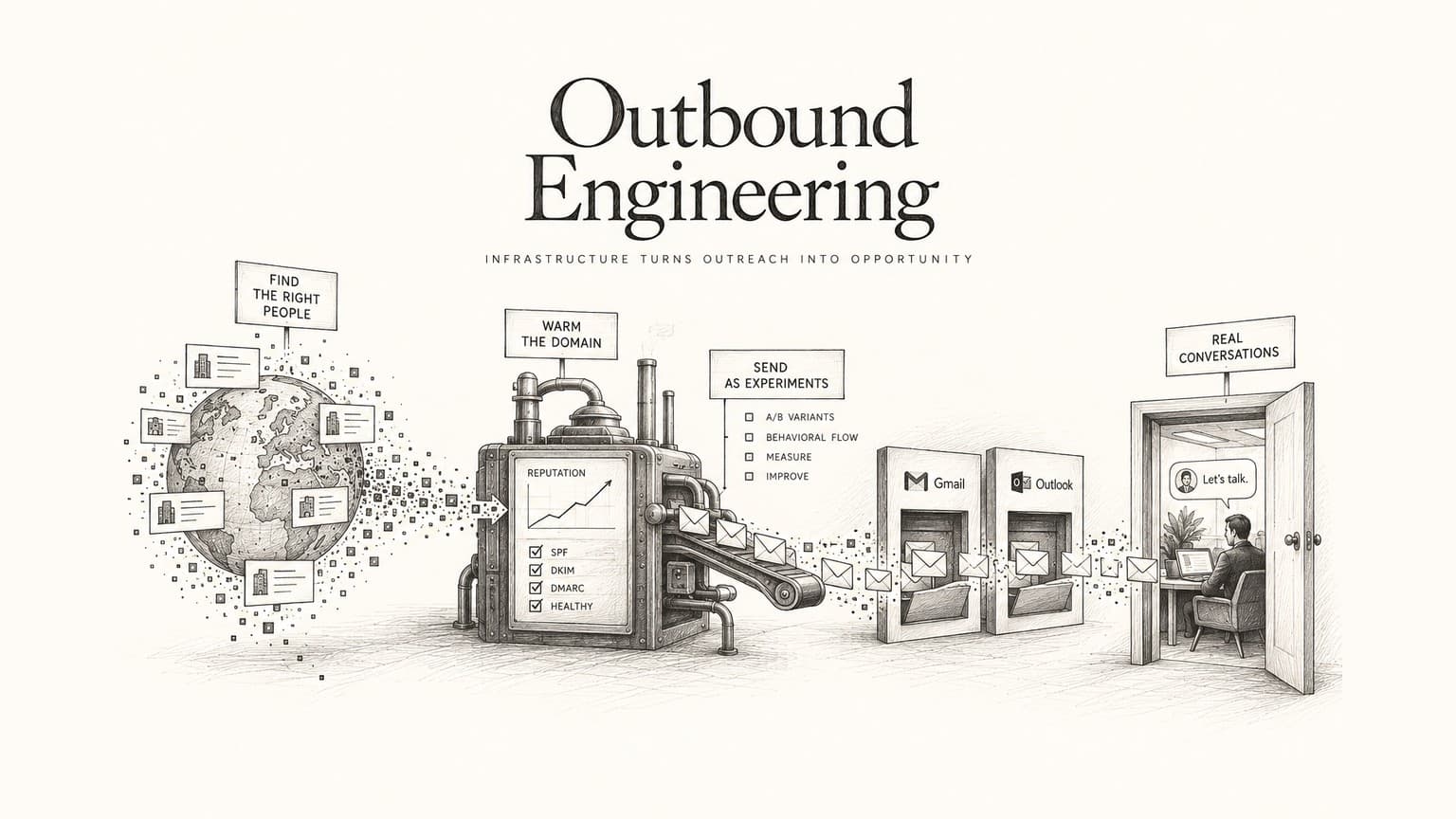
Most outbound fails the same way: a list gets bought, a template gets blasted, a domain gets burned, and the conclusion drawn is "outbound doesn't work." I have run outbound since 2015 — first as an affiliate marketer, where a single funnel returned 1,876% on ad spend, then operating a 60-person distributed sales team — and the throughline of everything that worked is that outbound is not a volume activity. It is a data pipeline with an email at the end.
This write-up covers the modern version of that pipeline: the one I build now, with agents in the loop, as three layers of infrastructure. Two of the layers ship as my own products; the third has been deployed for clients, described here generically.
Layer 1: earn the inbox before you use it
Nothing else matters if the message lands in spam, so the pipeline starts below the message — at the domain.
email-intel — open source, from the team behind warming.email — is infrastructure fingerprinting: given a domain, it resolves who actually runs its mail against a 36-service signature database, scores its anti-spoofing posture — SPF, DKIM, DMARC, STARTTLS — to a letter grade, and parses what raw headers reveal about the path a message took. Built in Swift 6 with zero external dependencies (DNS-over-HTTPS through URLSession, SMTP probing through Network.framework), shipped as a library, a CLI, and an MCP server so agents can run the same checks. It answers two questions most senders never ask: is my own house in order, and how paranoid is the receiver I am about to write to.
warming.email is the product on top: fixed-price domain warmup with readiness and health exposed as APIs — domain-readiness, warmup-health, warmup-state — so "can this domain send yet?" is a queryable fact rather than a feeling. A cold domain does not send campaigns. A warmed domain sends on a ramp, and the ramp is monitored.
The rule the layer enforces is simple: deliverability is a precondition, not a post-mortem.
Layer 2: the prospecting engine
The engine pattern started inside Vaivén, my media-intelligence product, and has since been replicated for clients — most recently for an industrial real-estate developer in northern Mexico that needed to find suppliers likely to require industrial space near a corridor where two global manufacturers were installing plants. Four stages:
Discover → Enrich → Score → Outreach.
The unit of work is not a row in a spreadsheet. It is a dossier: one versioned JSON document per company, under a declared schema, that accumulates everything the pipeline learns — and every field carries provenance. Where did this contact come from? Which page claimed this company supplies that manufacturer? A claim without a source does not enter the dossier, which means a personalization without evidence never reaches an email.
- Discover casts wide: agent-assisted web discovery plus commercial data sources, looking for companies matching the thesis.
- Enrich fills the dossier: contacts, roles, site signals, fit data.
- Score applies a written rubric — 1 to 10, with explicit bands: A (7–10) gets outreach, B (4–6) gets nurture, below 4 gets discarded. The rubric is a document under version control, so "why did we contact them?" always has an answer.
- Outreach is segmented sequences — different templates per thesis, email plus LinkedIn, with follow-ups — and a compliance module in the path, because outbound that ignores consent and opt-out rules is a liability generator with a send button.
The pipeline state lives in a queue file, the dossiers live in versioned storage, and the whole thing is inspectable after the fact. When a prospect converts, you can reconstruct exactly which evidence produced the conversation.
Layer 3: the funnel that catches the demand
Outbound creates attention; a funnel has to catch it. For a B2B industrial-supplies distributor in northern Mexico I built the receiving end as a quotation funnel: marketing pages targeting the intent queries their buyers actually type (product plus city), a quote-request flow that produces a structured lead instead of a contact-form email, a thank-you path, and activity tracking so the sales team sees what each prospect did before picking up the phone.
This is the same shape as the 2015 affiliate work — landing page, offer, measured conversion — with ten more years of discipline: the funnel is instrumented, the leads are structured, and the follow-up is a workflow rather than an inbox.
The same discipline as the eval harness
I write elsewhere about evaluation harnesses for AI agents — golden cases, judges, gates that can say no. Outbound engineering is the same discipline pointed at a different pipeline:
- A schema for the unit of work (the dossier, the golden case).
- Provenance for every claim (the field's source, the fixture's seed).
- A gate before anything irreversible happens (the scoring band and compliance check before a send, the judge's verdict before a release).
An email that cannot be traced to evidence does not get sent, for the same reason a release that cannot pass the gate does not ship. That is the whole method: the glamorous part of outbound is the copy, but the part that compounds is the infrastructure underneath it.
The practice now has its own home at outbound.engineering, with the definition, a glossary of its terms, and the measured numbers behind this write-up.