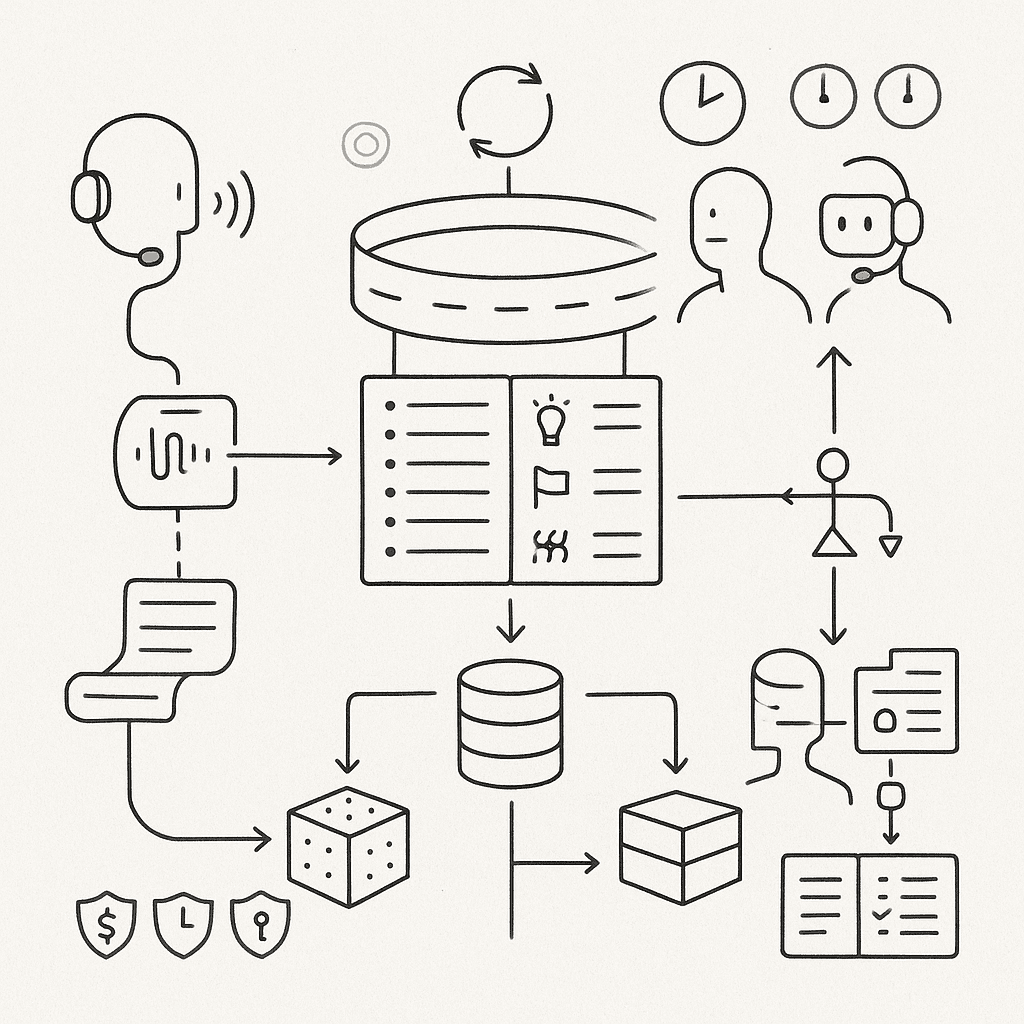
The construction of an artificial intelligence system for sales does not begin with the agent itself, but with the infrastructure that sustains it. The starting point is an AI-integrated dialer, designed to become the central work tool for sales representatives. This dialer, in its technical essence, operates as a function that connects with Twilio, leveraging its native capabilities for direct recording and transcription, without needing to pass audio through external systems like Whisper or set up additional servers.
What happens after each call is where the true value of the system resides. The complete transcript is extracted, interpreted, and sent to what we can call the Cognitive Infrastructure: a centralized core that stores not only the conversations themselves, but the processed knowledge that emerges from them. Here it is essential to distinguish between raw data and useful information. Vectorizing everything indiscriminately proves costly and inefficient. What makes sense is to apply a cognitive layer to each transcript—a process through which an agent analyzes specific call outcomes, evaluating salesperson competencies, reasons for success or failure, buying intent signals, and closing patterns.
This processed information is then vectorized selectively, using advanced embedding systems like those offered by MongoDB, which requires careful documentation of the schemas, fields, and structures needed to handle vectors efficiently. The result is an internal knowledge base that, from day one, can answer representatives’ questions, function as a training tool, generate scripts, and produce support materials for the entire sales team.
The next step involves identifying who is moving the needle within the organization. Without clarity on who the high-performing salespeople are and without ways to measure their KPIs, any attempt to build an agent will remain incomplete. Platforms like Gong already operate under this logic: they analyze the complete sales cycle and suggest real-time actions based on signals detected during conversations. The system proposed here goes further, as it not only identifies opportunities but stores the cognitive interpretations of each call, building over time a structured knowledge repository that includes reasons for purchase, frequent objections, effective sales styles, and closing signals.
Based on this foundation, the system evolves through reinforcement learning toward creating an AI agent with voice capabilities, internalized scripts, and the knowledge needed to conduct calls from beginning to end. This agent does not emerge from nowhere; it emerges from the intelligent accumulation of patterns extracted from human best practices. Once the first agent meets the defined KPIs, the infrastructure can scale to generate multiple agents and develop an internal algorithm that assigns calls efficiently to both humans and artificial intelligences.
The final vision is an ecosystem where the best human salespeople are preserved and empowered, while AI agents effectively assume the calls assigned to them. It is not about replacing people, but about building a system that learns from those already succeeding and replicates that knowledge in a scalable way. The resulting agent not only speaks fluently but genuinely understands what is happening in the pipeline and with whom it is best to take action at each moment. All of this, built step by step, without magic, but with the correct architecture from the beginning.