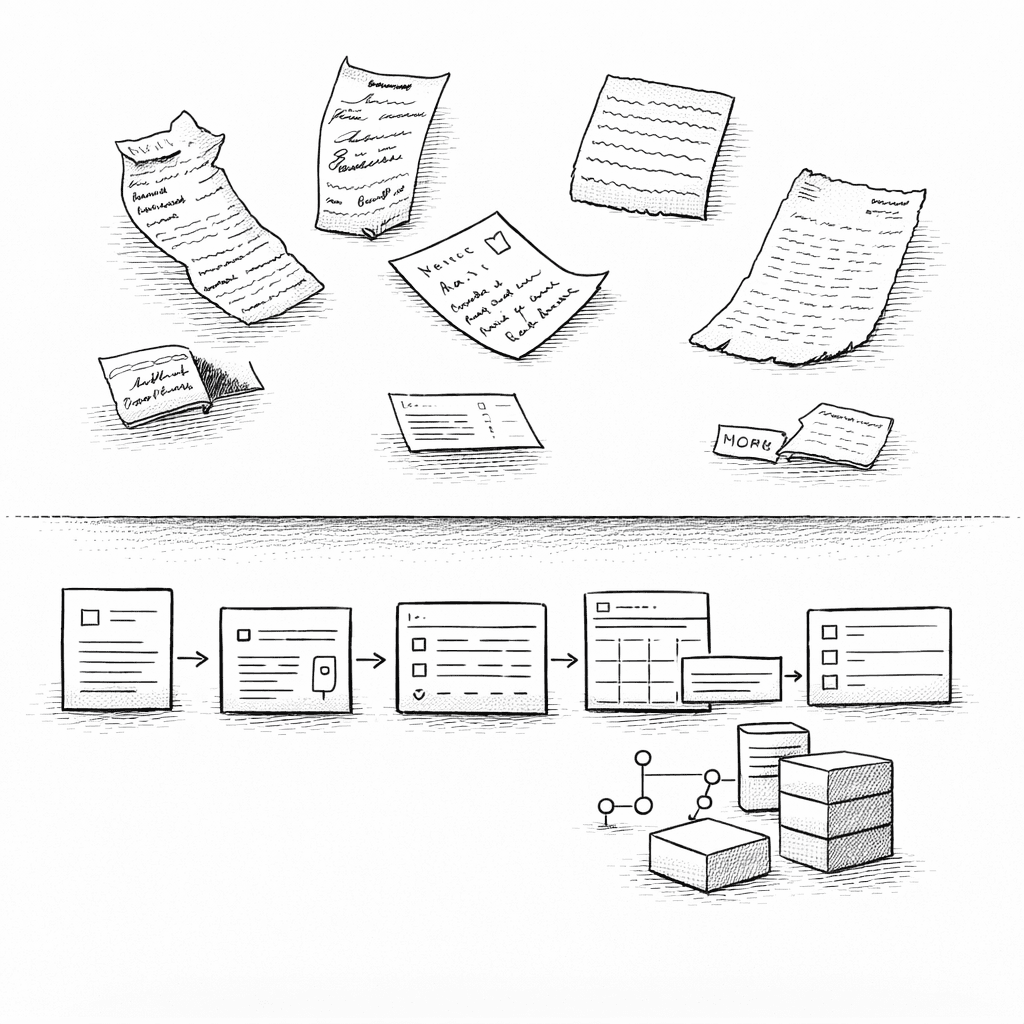
Mistral just released a new OCR 3 model specialized in extracting text from images or any file format.
The promise is simple. Every written thing becomes readable by machines. Not just the clean typeset document but the receipt crumpled in a pocket, the prescription scrawled in haste, the manuscript aging in an archive no one has opened in decades. The entire written record of human activity, legible at scale.
This is what the market is converging toward. Not general intelligence but specialized competence. Models that do one thing with such reliability that the task disappears from consideration. OCR. Translation. Transcription. Summarization. Each capability, once difficult enough to structure workflows around, becomes ambient. Infrastructure rather than feature.
The architectural shift is not about any single model. It is about the threshold at which capability becomes assumption. When extraction is reliable, you stop thinking about extraction. You think instead about what to do with the extracted. The constraint moves up the stack.
What this unlocks is not a new tool but a new starting point. The boundary between analog and digital, between written and structured, dissolves. A handwritten notebook becomes a searchable database. A century of paper records becomes a training set. The friction that once made preservation expensive and access difficult simply leaves.
To call this solved is to miss the point. The question was never whether machines could read. The question was what happens when reading costs nothing. When every surface that holds text becomes, in principle, an input field.
The answer is still arriving.