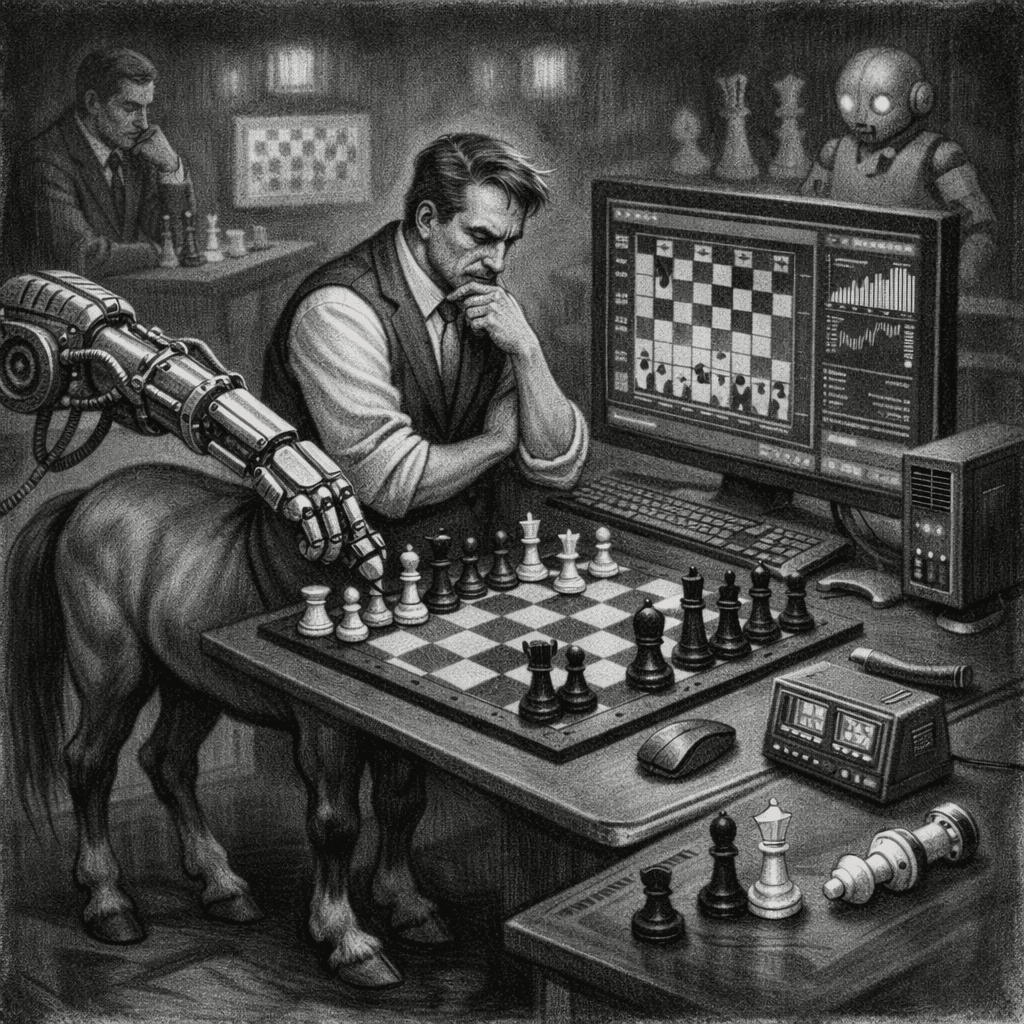
After Garry Kasparov lost to Deep Blue in 1997, he did something more interesting than sulk. He asked a different question. Instead of wondering whether machines were better than humans, he started wondering what would happen if you put them together.
The answer turned out to be surprisingly good. In “freestyle” chess tournaments, where players could consult engines mid-game, the best teams were not grandmasters. They were not supercomputers either. They were decent players who were very good at working with computers. A strong amateur plus a good engine plus a smart process beat both the world champion and the best standalone machine.
People called this a “centaur.” Half human, half machine. It was a beautiful idea. It suggested that the future of intelligence was not about replacement but about collaboration. Humans bring intuition, context, and the ability to frame problems. Machines bring speed, depth, and tireless precision. Together, something greater than either.
This idea spread fast. Finance, medicine, law, management consulting. Everyone loved it. It felt democratic. It felt hopeful. It said that humans would always have a seat at the table, as long as they learned to work with the tools. It became the default optimistic story about AI. Humans plus machines. Better together. Forever.
Except that is not what happened in chess.
For roughly a decade, centaurs really did dominate. From the early 2000s to the early 2010s, human-computer teams were the strongest chess-playing entities on the planet. But then the engines kept getting better. They got better at evaluating positions. They got better at long-term planning. They got better at the very things humans were supposedly contributing.
And slowly, the human in the loop started becoming a bottleneck.
Not because the humans got worse. Because the machines got good enough that human input was no longer adding signal. It was adding noise. The best engine alone became stronger than any human-engine team. The centaur era ended not with a dramatic defeat but with a quiet irrelevance.
This matters far beyond chess.
The pattern is clear if you are willing to look at it honestly. Centaurs appear when machines are strong but incomplete. Humans provide scaffolding during that phase. They fill in the gaps. They correct the errors. They supply the judgment the machine has not yet learned to internalize. This is genuinely valuable work. It creates real leverage and real opportunity.
But it is a phase. Not a destination.
The scaffolding only matters while the building is going up. Once the structure can stand on its own, the scaffolding comes down. Not because anyone decided to remove it. Simply because it stopped being load-bearing.
I think we are in a centaur moment right now across many domains. Doctors working with diagnostic AI. Lawyers using language models to draft briefs. Programmers collaborating with code assistants. Writers editing AI-generated text. In each case, the human adds something the machine cannot yet do well on its own. And in each case, that “cannot yet” is doing a lot of heavy lifting in the sentence.
The tempting mistake is to assume that because human judgment adds value today, it will add value forever. That the loop will always need a person in it. People made exactly this mistake in chess. They assumed the centaur was the final form. It was not. It was the transitional form.
This does not mean you should ignore the centaur moment. Quite the opposite. The transitional period is where enormous value gets created. The people who learned to work with chess engines in 2005 had a genuine edge. The people who learn to work with AI effectively right now have a genuine edge. You should absolutely ride this wave.
But you should ride it knowing it is a wave.
The real question is not how to be a better centaur. The real question is what you do when the centaur era ends in your field. When the machine no longer needs your corrections. When your judgment is no longer the scarce input. When the loop closes.
The honest answer is that nobody knows yet. But the first step is to stop telling yourself a comforting story about permanent partnership and start thinking about what it means when the partner outgrows you. In chess, the humans who thrived after the centaur era were not the ones who kept trying to add value to engines. They were the ones who found entirely new games to play.
The same will probably be true for the rest of us. The centaur is real. The centaur is powerful. And the centaur is temporary. Plan accordingly.